The Little Capsule That Conquered the World — A South African Guide to Coffee Pods
From a Swiss engineer's 1970s idea to the Nespresso machine in your hotel room: the full history of coffee pods, how capsule machines work, what pods really cost in SA, and how to pull the best cup.
Key Takeaways
- Espresso, by definition, is hot water forced through finely ground coffee under high pressure.
- "Pod" gets used for everything, but the formats are not interchangeable — and in South Africa the choice mostly comes down to the first three.
- The Tsogo Sun's card covers the mechanics.
The Little Capsule That Conquered the World — A South African Guide to Coffee Pods
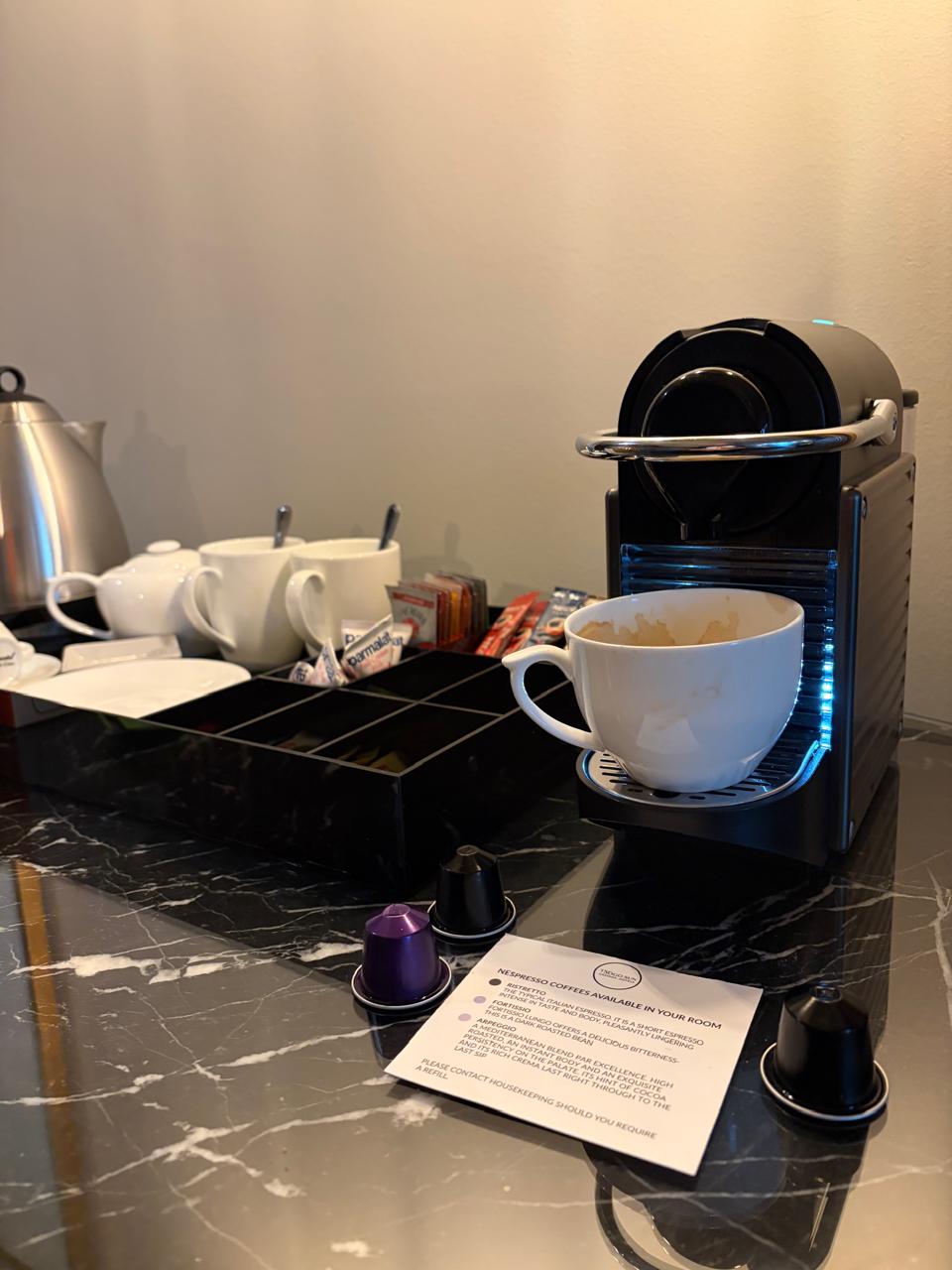
It started with a Swiss engineer's holiday in Rome and a barista's party trick. Fifty years later there's a pod machine in your kitchen, your office — and your hotel room. Here's the full story of the coffee capsule, how it actually works, what it costs in rand, and how to pull a properly good cup from one.
The hotel-room test
Recently I checked into a Tsogo Sun hotel on Durban's Golden Mile. Sunrise over the Indian Ocean, surfers already in the water — and on the marble counter, a small black Nespresso Pixie, three capsules (Ristretto, Fortissio Lungo and Arpeggio), and a neatly printed card titled "7 Steps to the Ultimate Coffee Experience."
That card is the whole pod story in miniature. Fifty years of engineering, patent wars and billion-dollar marketing, compressed into seven steps a jet-lagged guest can follow before their first meeting: press the button, fill the tank, lift the handle, drop in a capsule, close it, choose your cup size, and bin the spent pod. No grinder, no tamper, no mess, no skill required.

The view deserves a decent coffee. And the Pixie delivers — in 25 seconds flat. The crema was thick, golden, aromatic. The Ristretto was punchy and short, exactly the kind of wake-up shot you want when the ocean is still pink.
But how did we get here? How did a single-serve aluminium thimble become the way millions of people — and nearly every hotel on earth — make coffee?
Reading the hotel capsule menu
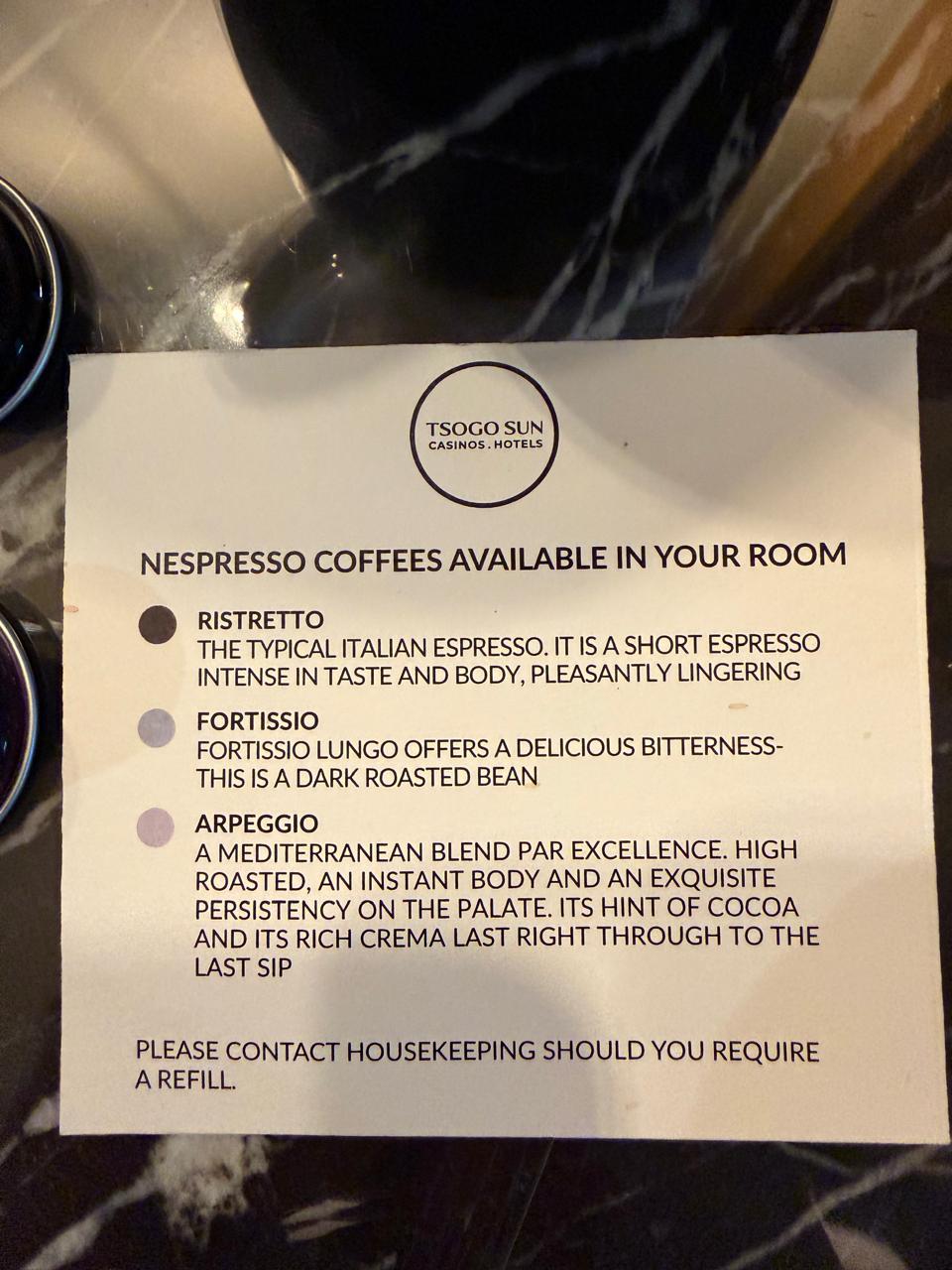
The Tsogo Sun card is a compact masterclass in what capsule "intensity" actually means. Three capsules, three different experiences:
Ristretto — the typical Italian espresso. Short, intense in taste and body, pleasantly lingering. This is the one you choose when you want flavour concentration: everything coffee can give you, compressed into 25 ml.
Fortissio Lungo — a dark-roasted bean designed for a longer pour. It offers a delicious bitterness and more volume without losing body. A good pick if you want a proper drink, not just a sip.
Arpeggio — a Mediterranean blend par excellence. High roasted, with an instant body and an exquisite persistence on the palate. Its hint of cocoa and its rich crema last right through to the last sip. If you're choosing one capsule to judge the whole system by, this is the one.
A note those intensity numbers don't tell you: they describe roast depth and body, not caffeine content. An intensity-10 Ristretto and an intensity-4 lungo carry similar caffeine — there's simply more water in one of them. If you want maximum flavour, go short. If you want a longer sipper, pick a lungo capsule rather than running a short capsule long.
The 7 Steps — and why they matter
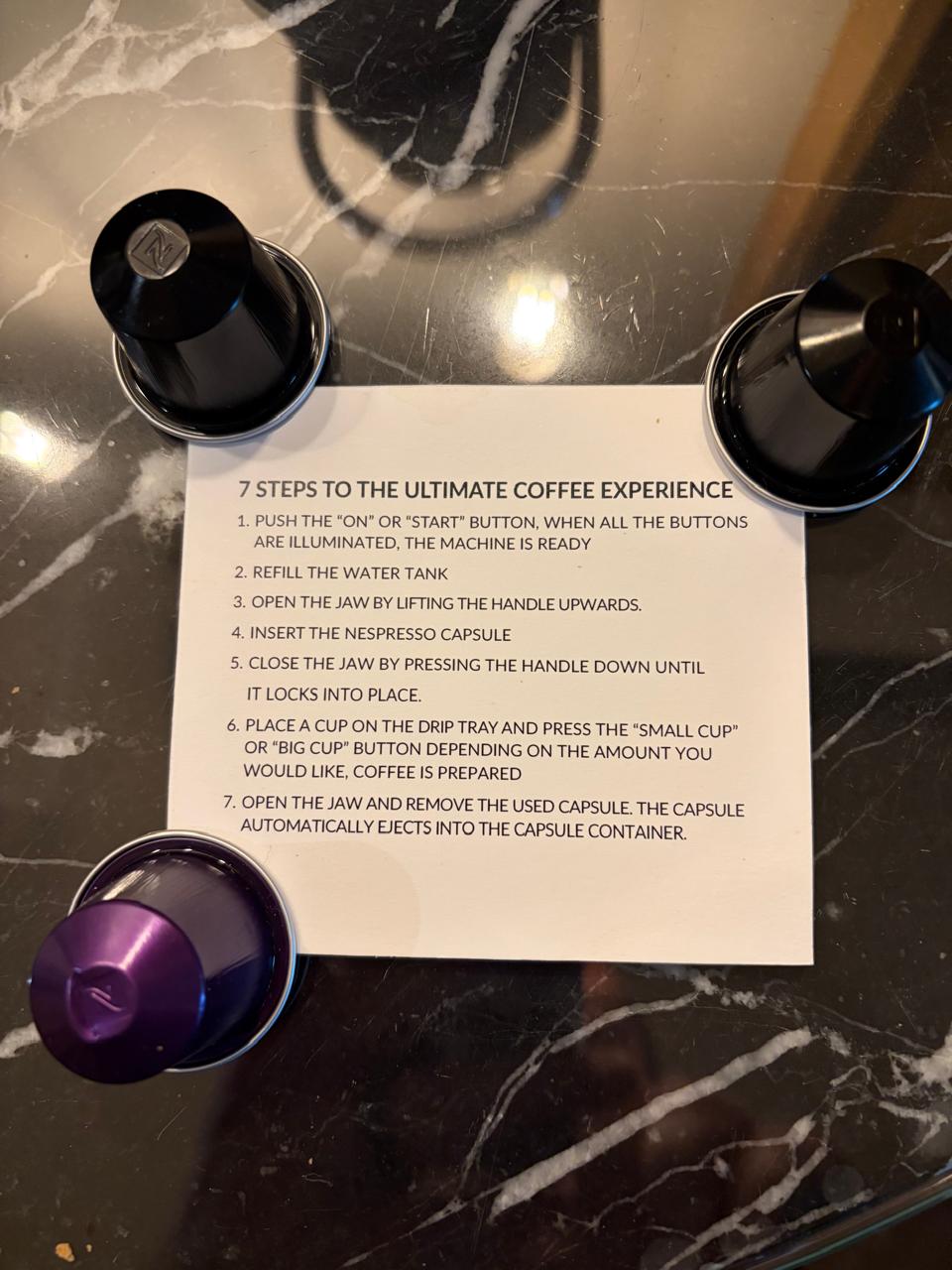
The hotel card lays it out plainly:
- Push the "ON" or "START" button. When all the buttons are illuminated, the machine is ready.
- Refill the water tank.
- Open the jaw by lifting the handle upwards.
- Insert the Nespresso capsule.
- Close the jaw by pressing the handle down until it locks into place.
- Place a cup on the drip tray and press the "small cup" or "big cup" button depending on the amount you would like. Coffee is prepared.
- Open the jaw and remove the used capsule. The capsule automatically ejects into the capsule container.
Seven steps. No grinder to calibrate, no portafilter to dose, no tamping pressure to debate. That's the capsule's entire value proposition distilled into a laminated card on a marble counter — and it's why Nespresso owns the hotel market worldwide.
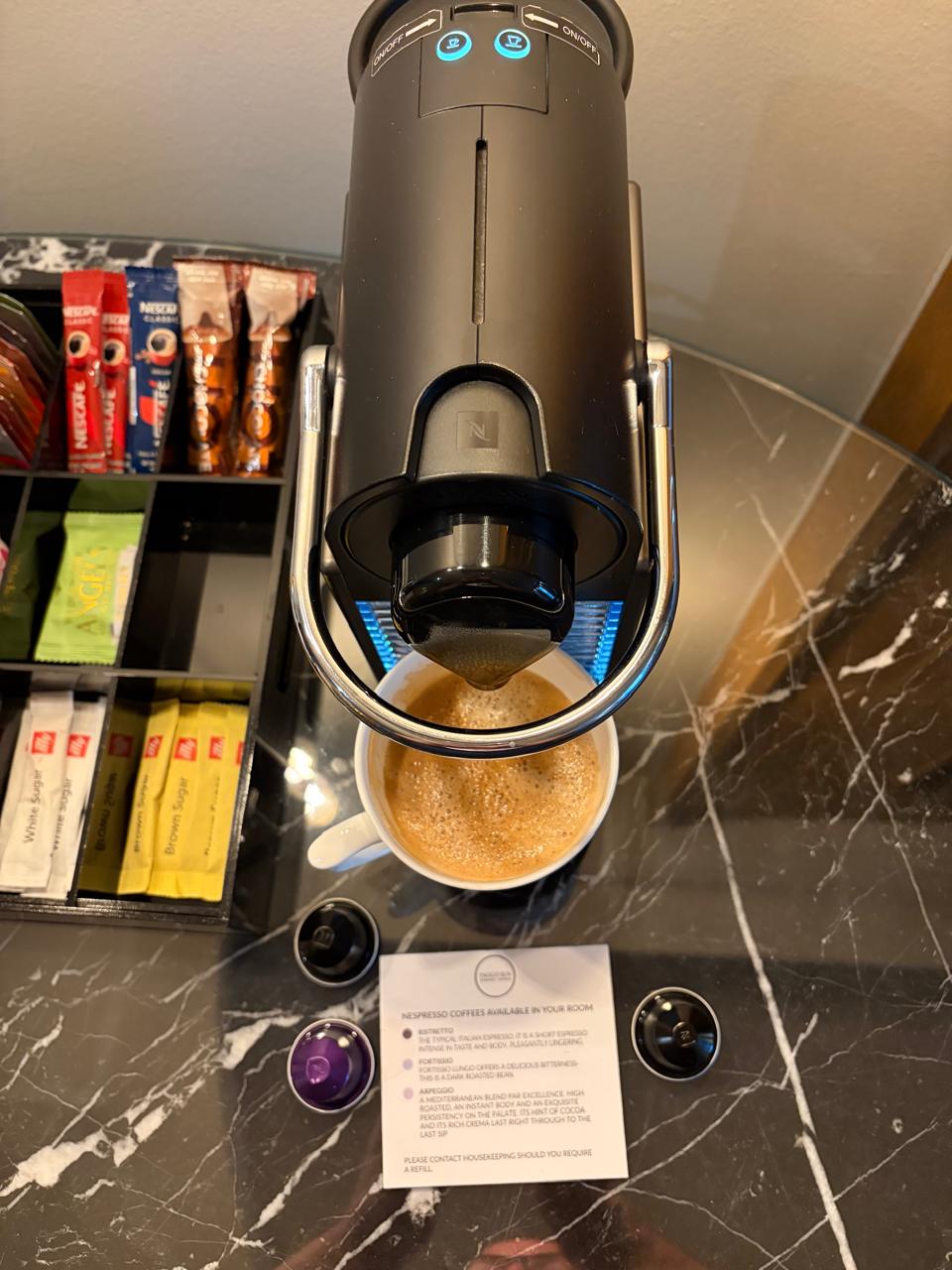
But the Tsogo Sun's seven steps only get you a decent cup. If you own the machine at home, there are ways to get more out of it. I'll come back to that.
The view from the 12th floor

Durban waking up. Somewhere below, a thousand hotel-room Pixies are already humming. There's something about drinking a proper espresso — crema intact, bitter-sweet, ceramic warm in your hand — while watching the sun clear the Indian Ocean. It's a small luxury, and that was always the point. Eric Favre, the engineer who started all this, didn't invent a coffee machine. He invented a way to make a moment — identical every time, in every room, without a barista.
And that story starts in Rome.
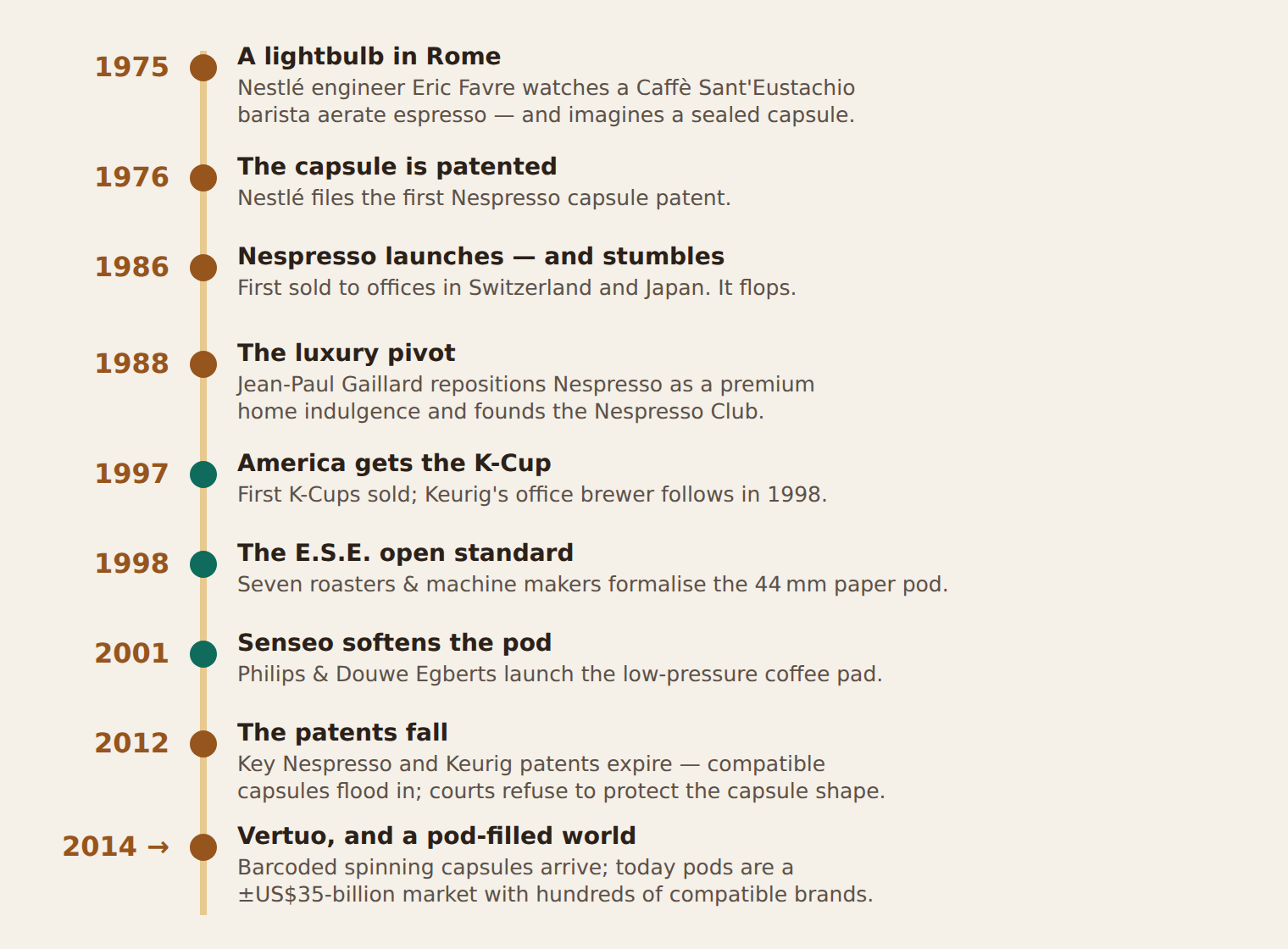
A lightbulb in Rome: the 50-year history of the coffee pod
1975: the engineer and the barista
The coffee capsule was born out of professional jealousy — Nestlé's, of Italy. In 1975 a young Swiss engineer named Eric Favre joined Nestlé's packaging division. On a trip to Rome with his Italian wife Anna-Maria, he queued at Caffè Sant'Eustachio, a bar near the Pantheon that drew longer lines than any other espresso bar in the city. The secret, he noticed, was in the barista's wrist: he pumped the machine's lever in short bursts, aerating the water before it hit the coffee. More air, more oxidised oils, more crema — and a rounder, more aromatic shot.
Favre's insight was that a machine could do the barista's trick automatically, if the coffee lived in a sealed capsule that trapped air and aroma, and the machine forced hot water through it under pressure. Nestlé filed the first capsule patent in 1976.
1986: the launch that flopped
Nestlé, then the world's instant-coffee superpower, sat on the idea for a decade — capsules looked like a threat to Nescafé, not an opportunity. When Nespresso finally launched in 1986, it targeted offices in Switzerland and Japan. It flopped. Offices didn't want to pay premium prices for coffee by the cup.
The rescue came in 1988 from a marketer named Jean-Paul Gaillard, who did the opposite of everything Nestlé knew: he pushed prices up sharply, aimed the machines at affluent households instead of offices, and created the members-only Nespresso Club. Scarcity, luxury, direct-to-consumer — decades before those became e-commerce clichés. It worked. By the 2000s Nespresso was Nestlé's fastest-growing brand, later fronted by George Clooney's raised eyebrow.
Trivia for your next braai: Favre left Nestlé in 1991 to found his own capsule company, Monodor, which later licensed technology to Lavazza. Swiss profiles of the inventor estimate that more than half of all coffee capsules bought worldwide trace back to his original design — and he reportedly drank around ten espressos a day well into his seventies.
Meanwhile: pods for everyone else
Nespresso wasn't alone for long. The Italian espresso establishment answered with the E.S.E. (Easy Serving Espresso) pod — a 44 mm paper "teabag" holding 7 g of compressed espresso grind, formalised as an open standard in 1998. In the US, Keurig put its first K-Cups on sale in 1997 and shipped its first brewer in 1998, conquering the American office with drip-style coffee in a plastic cup. In 2001, Philips and Douwe Egberts launched Senseo, a soft low-pressure coffee pad for mild, frothy coffee. Different formats, same promise: one cup, zero effort, identical every time.
2012: the patents fall
Nespresso's fortress was built on roughly 1,700 patents. From 2012 the key ones began expiring, and rivals pounced with "Nespresso-compatible" capsules at a fraction of the price. Nestlé fought back in court — and lost repeatedly, with both German and Swiss courts ruling that a technical shape can't be locked up as a trademark after its patents lapse. The result is today's market: hundreds of compatible-capsule brands, which is exactly why your local Checkers now sells a sleeve of Nespresso-compatible capsules for half the price of the original.
How a capsule espresso machine actually works
Espresso, by definition, is hot water forced through finely ground coffee under high pressure. A capsule machine is simply a very small, very automated espresso machine — with the grinding, dosing and tamping done in a factory instead of on your counter.
Inside that little Pixie on the hotel counter, five things happen in about 30 seconds:
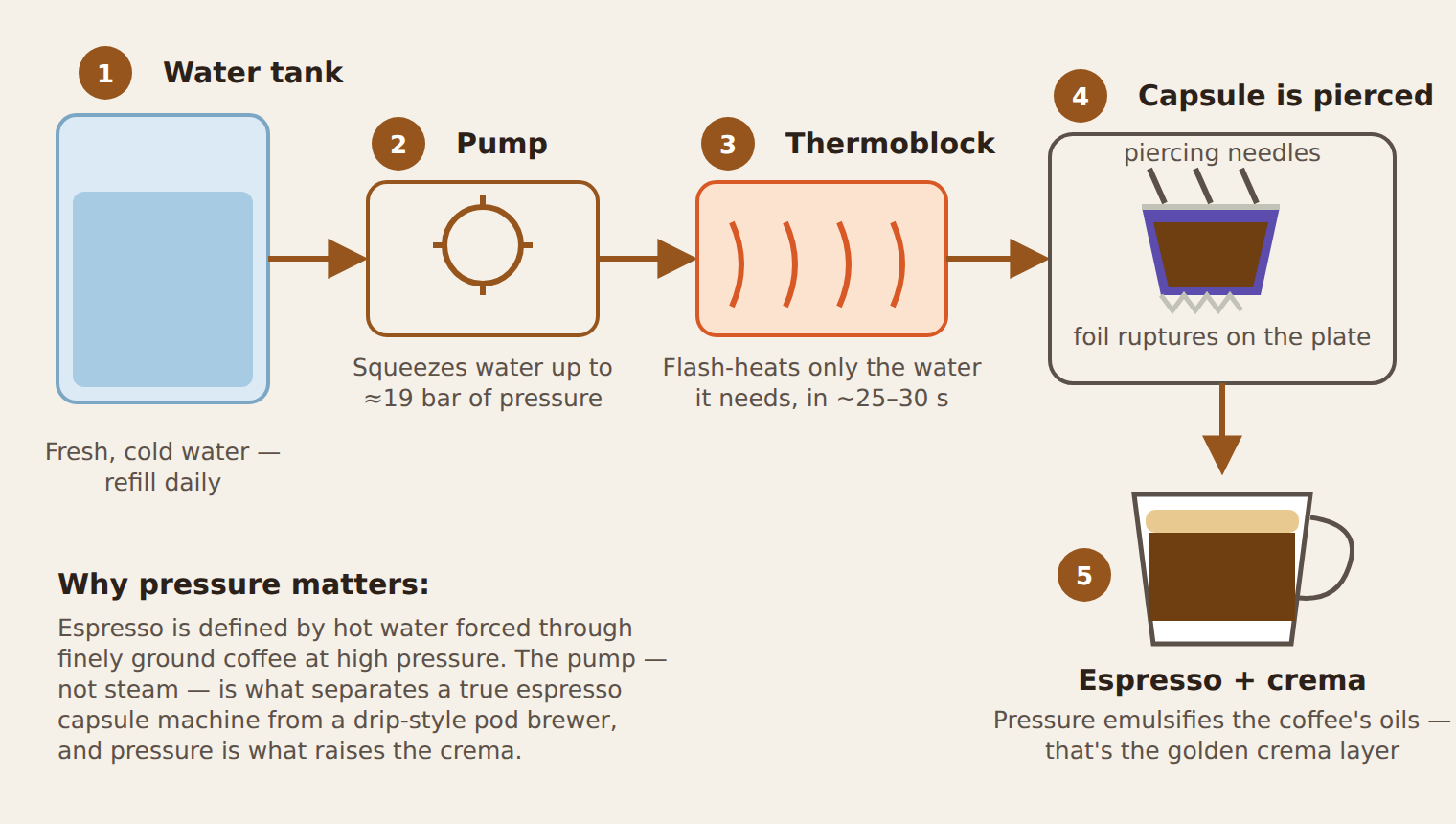
- The pump pressurises. A small vibration pump squeezes water up to a claimed 19 bar — the effective standard for proper espresso extraction is around 9 bar, which is what raises crema.
- The thermoblock heats. Instead of a boiler, a thermoblock flash-heats only the water needed for your cup to roughly 90–95 °C — which is why the machine is ready in under a minute.
- Needles pierce the capsule. Three small spikes puncture the flat top of the capsule and inject the hot, pressurised water.
- The coffee blooms and the foil ruptures. The grounds swell, pressure builds, and the capsule's base membrane deforms against a spiked plate until it bursts — instant, self-made filter.
- Espresso, with crema. The pressure emulsifies the coffee's oils into that golden layer on top. The capsule kept the grounds sealed from oxygen (Nespresso flushes capsules with nitrogen before sealing), which is why a months-old pod still tastes fresh.
19 bar vs 9 bar — the honest version: the big number on the box is the pump's maximum, not what your coffee experiences. Real espresso extraction happens around 9 bar; below ±7 bar you get sour, thin coffee with weak crema, and far above 10 bar you drag out bitterness. Pod machines are engineered to land in the sweet spot — one reason they beat most cheap "15-bar" manual machines used badly.
The exception is Nespresso's newer Vertuo system, which doesn't pump-pressurise at all: it reads a barcode on the capsule rim and spins the pod at up to 7,000 rpm ("Centrifusion"), spinning water through the grounds. It brews everything from espresso to full mugs — but purists note its foam is more spin-foam than true pressure-brewed crema.
Know your pod: the five formats that matter
"Pod" gets used for everything, but the formats are not interchangeable — and in South Africa the choice mostly comes down to the first three.
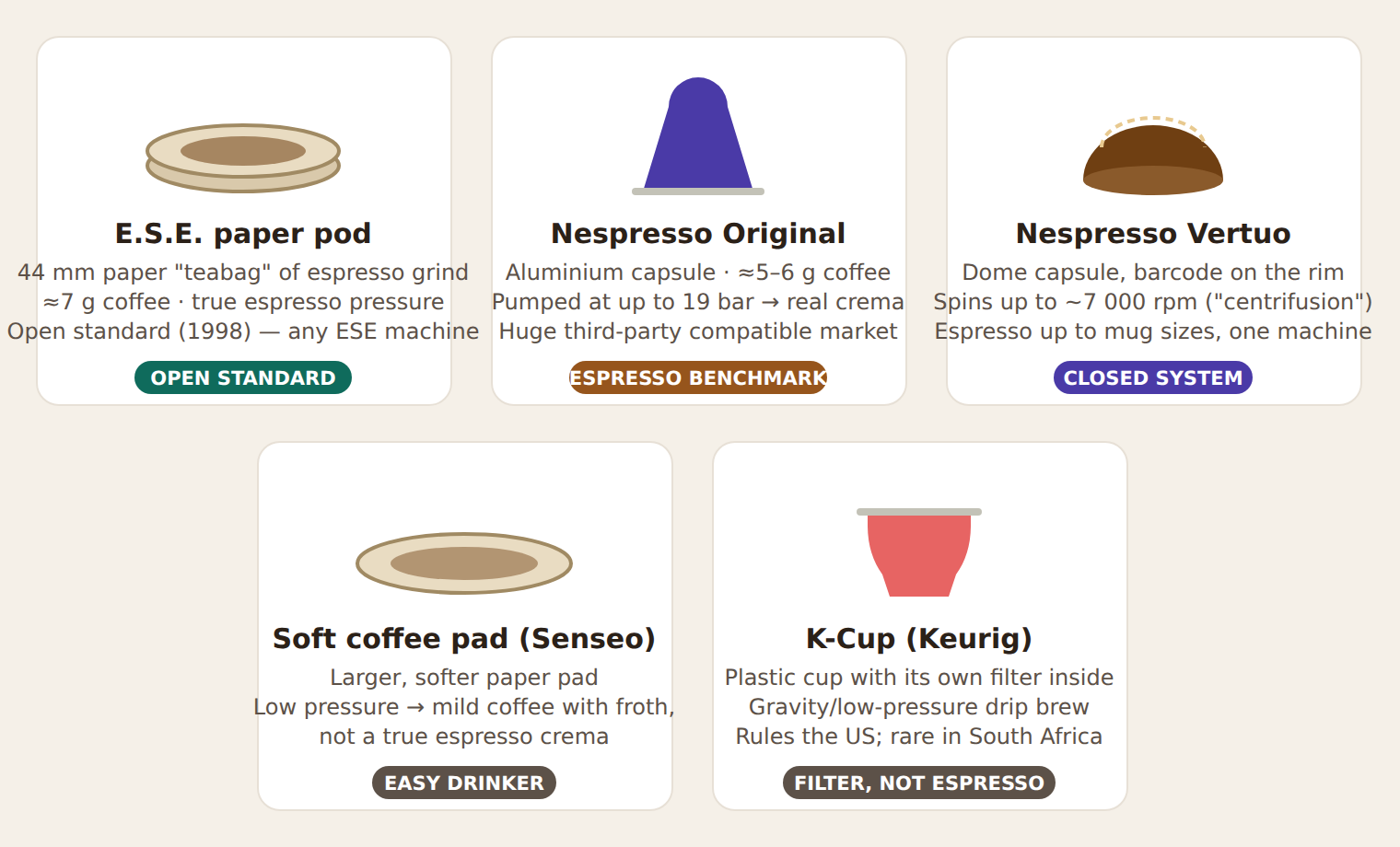
E.S.E. paper pod — 44 mm paper "teabag" of espresso grind. ≈7 g coffee, true espresso pressure. Open standard (1998) — any ESE machine. The purist's choice.
Nespresso Original — Aluminium capsule, ≈5–6 g coffee. Pumped at up to 19 bar → real crema. Huge third-party compatible market. The espresso benchmark.
Nespresso Vertuo — Dome capsule, barcode on the rim. Spins up to ~7,000 rpm ("centrifusion"). Espresso up to mug sizes, one machine. Closed system.
Soft coffee pad (Senseo) — Larger, softer paper pad. Low pressure → mild coffee with froth, not a true espresso crema. Easy drinker.
K-Cup (Keurig) — Plastic cup with its own filter inside. Gravity/low-pressure drip brew. Rules the US; rare in South Africa. Filter, not espresso.
What it costs in South Africa (July 2026)
Here's the honest maths, in rand.
The machines
| Machine | System | Typical price |
|---|---|---|
| Nespresso Vertuo Pop | Vertuo | from ±R2,100 |
| Nespresso Essenza Mini | Original | ±R2,400 |
| Nespresso Vertuo Next | Vertuo | ±R3,500 |
| Nespresso Lattissima One (auto milk) | Original | ±R3,500 |
| Nespresso Gran Lattissima | Original | ±R5,000 |
| Nespresso Vertuo Creatista (steam wand) | Vertuo | ±R9,900 |
Prices from Nespresso SA, Takealot and PriceCheck listings, July 2026 — shop around, they move with promotions.
The capsules — and the cup-for-cup truth
Official Nespresso Original capsules run R120–R135 per sleeve of ten (R12–R13.50 a cup). Compatible capsules from local suppliers start under R4–R7 a cup, and supermarket house brands sit in the same band. Vertuo capsules — still effectively a closed system thanks to that barcode — cost more, around R14–R16 a cup.
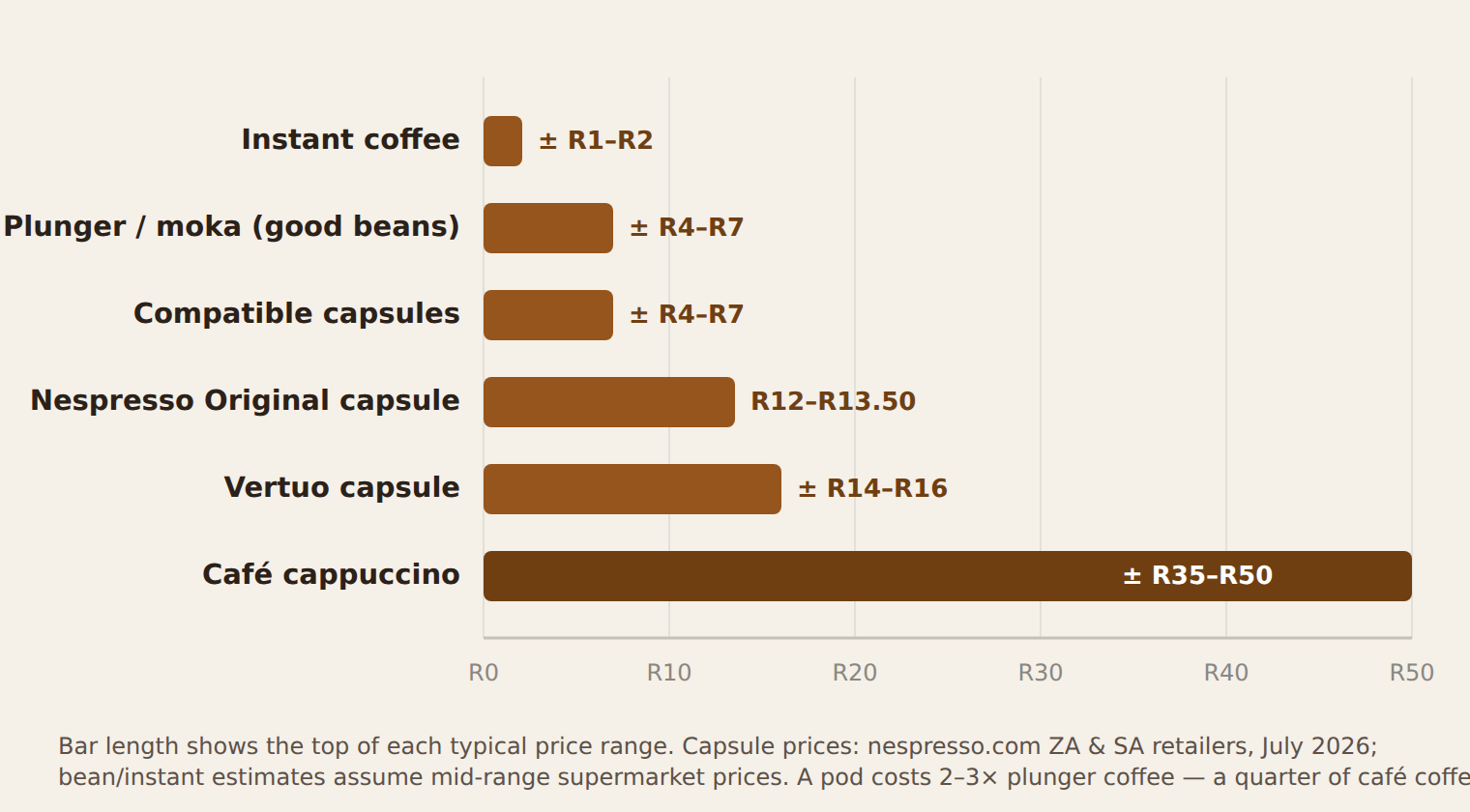
Two ways to read that chart. Against beans, pods are expensive: R12.50 a capsule is roughly R1,800–R2,500 per kilogram of coffee — triple the price of excellent local specialty beans. Against the café habit, pods are a bargain: swap one bought cappuccino a day for a home capsule and you save around R800–R1,100 a month — the machine pays for itself inside a quarter. That's the pod's true value proposition, and it's why the hotel puts a Pixie in the room instead of a kettle and sachet.
Ten ways to pull a better cup from any pod machine
The Tsogo Sun's card covers the mechanics. But if you own the machine, a few habits separate an okay pod coffee from one that surprises people:
- Run a blank shot first. Lift the handle (no capsule), run a small cup of hot water through. This flushes stagnant water and old residue and — crucially — preheats the brew chamber and your cup. Cold cups murder crema.
- Use fresh water daily. The tank is not a storage vessel. Coffee is 98% water; stale tank water tastes like exactly that. If your municipal water is hard or heavily chlorinated, filtered water noticeably improves the cup.
- Match the button to the capsule. An espresso capsule holds ±5–6 g of coffee — designed for a 40 ml shot. Pressing the lungo button on it just rinses bitterness through spent grounds. Want a long drink? Use a lungo capsule, or pull a proper short shot and top with hot water (a pod Americano).
- Go shorter for sweetness. Many machines let you reprogram pour volumes. Cutting the standard 40 ml espresso to ±25–30 ml gives a noticeably sweeter, more syrupy shot. Watch the stream: when it turns pale ("blonde"), everything after is bitter water.
- Eject the capsule immediately. A spent pod left in the chamber stews, breeds off-flavours — and in humid coastal air, worse.
- Descale every 3 months or 300 capsules — whichever comes first, and monthly-ish if you're in a hard-water area. Scale buildup slows flow, drops temperature and flattens flavour. Use a proper descaler, not vinegar, which can damage seals.
- Run a cleaning capsule occasionally. Coffee oils coat the brew chamber and turn rancid. A cleaning capsule (e.g. Caffenu, made right here in SA) every month or two keeps the pathway fresh — this is separate from descaling.
- Store capsules cool and dark, and mind the date. Sealed capsules keep far longer than open beans, but they're not immortal — flavour fades gently past best-before.
- Never reuse a capsule. The second run is brown sadness. If cost per cup stings, switch to compatibles rather than double-dipping.
- Take milk as seriously as coffee. Fridge-cold fresh milk, frothed properly (an Aeroccino, a French press plunged vigorously, or a hand frother), turns a pod espresso into a genuinely good flat white. Long-life milk froths, but tastes like the box.
The 30-second upgrade summary: hot cup, fresh water, right button, quick eject, clean machine. Do those five and a R2,400 machine with a R6 compatible capsule will embarrass plenty of café coffee.
The verdict from the 12th floor
Is pod espresso the best coffee you can make? No — a skilled hand with a grinder, fresh beans and even a moka pot will beat it on flavour and on price per cup. But that was never the pod's fight. Favre's capsule won because it made good-enough espresso inevitable: identical in a Sandton boardroom, a Vaud farmhouse and a Durban hotel room at 6 am, before the sun has cleared the Indian Ocean.
Fifty years on, the numbers say the capsule isn't going anywhere — it's a $35-billion habit growing 6% a year. Your job as a coffee lover is simply to use it well: buy the machine once, buy smarter capsules forever, keep it clean, pull it short, and recycle the empties. And when a hotel leaves you a Ristretto, a Fortissio and an Arpeggio on the counter — now you know exactly which button to press.
Have a pod machine hack we missed, or a favourite SA compatible capsule? Drop it in the comments — we test the best claims for a follow-up.
Sources & further reading: Eric Favre & Nespresso history: WIPO Magazine; House of Switzerland. Machine mechanics: Favre via WIPO Magazine; Nespresso technical documentation. E.S.E. standard: ESE Consortium (1998). Keurig history: Tuck School of Business (Dartmouth). Market size: Mordor Intelligence (2026–2031). SA pricing: nespresso.com/za, Takealot, PriceCheck — July 2026.

About the author
Bibi Burness, founder of Coffee Journal, has profiled 50+ SA specialty roasters and tested 10+ bottled water brands against the SCA standard. He completed the Bean There and Bluebird one-day home-barista courses in 2026 and maintains the site's transparency trust-score system.
Read more on the About page →