Arabica vs Robusta: The Real Difference — and South Africa's Chicory Story
Researched and fact-checked, August 2026. Tasted and read, not sponsored.
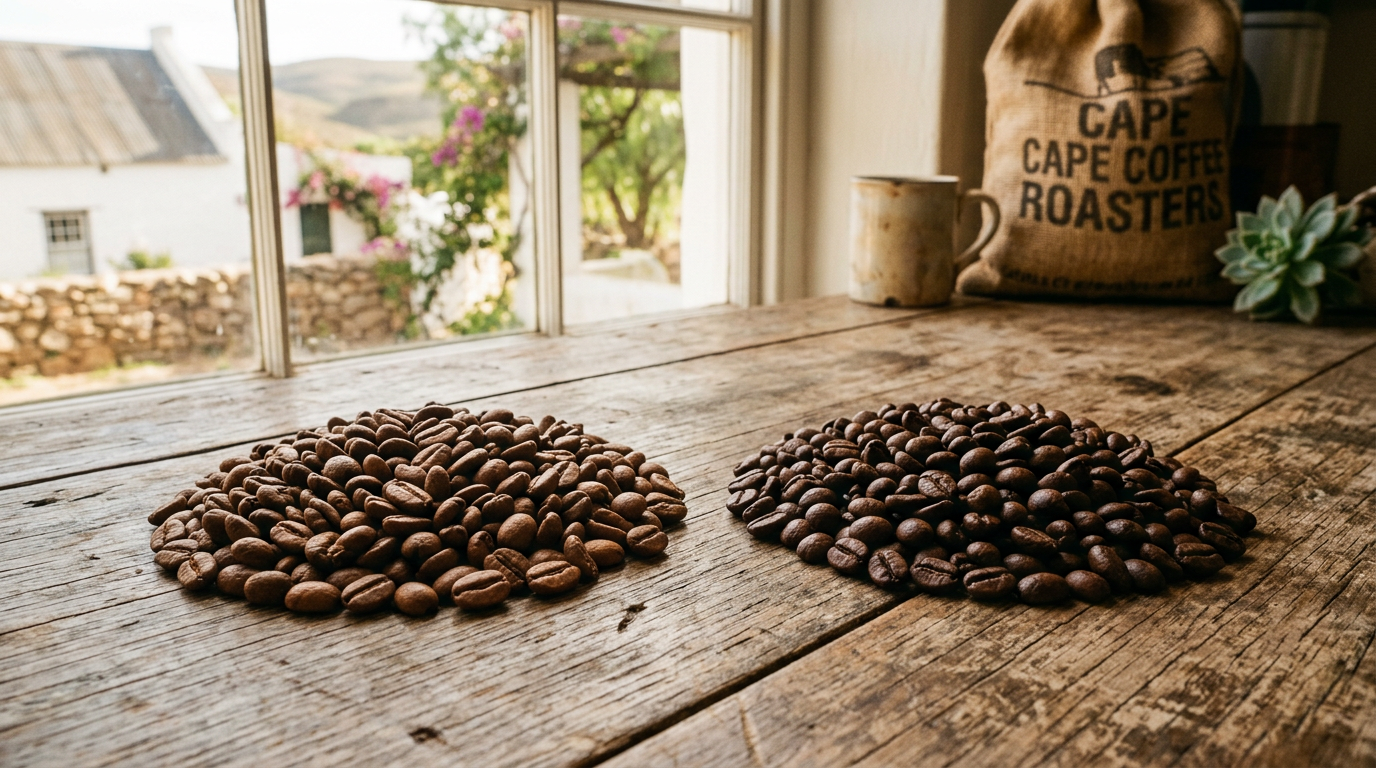
Arabica (left) vs robusta (right): two different plants, with a lot of overlap the labels don't tell you about.
Arabica and robusta are the two commercially dominant types of coffee, but their differences go beyond one being "smooth" and the other "strong." Arabica often produces sweeter, fruitier and more aromatic cups, while robusta — more precisely Coffea canephora — commonly brings greater bitterness, body and caffeine. Yet species is only one influence on flavour. And in South Africa there's another ingredient in the cup entirely: chicory, a roasted root that isn't coffee at all. The word we use for our oldest brew, moerkoffie, literally means "sediment coffee." Both of those stories are worth knowing before you pick a side.
Arabica vs robusta at a glance
Here's the comparison, then the detail underneath. Read the last row first — it's the one most "arabica good, robusta bad" articles leave out.
| Arabica | Robusta (Canephora) | |
|---|---|---|
| Botanical name | Coffea arabica | Coffea canephora |
| Flavour tendency | Often sweeter, fruitier, more acidic and aromatic | Often fuller-bodied, more bitter, earthier or woodier |
| Relative caffeine | Lower — often cited around 1–1.5% | Higher — often around double arabica's level |
| Growing conditions | Higher altitudes, milder temperatures, more disease-prone | Lower altitudes, hotter climates, hardier, higher-yielding |
| Common commercial uses | Most specialty and single-origin coffee sold today | Widely used in instant coffee and in some espresso blends |
| Quality caveat | Species is only one factor — origin, cultivar, processing, roast and brewing can outweigh it | The same applies: lower-grade and carefully grown high-quality canephora both exist |
Taste and flavour
Arabica is the one people describe with wine words: fruity, floral, sweet, bright. It typically carries more sugars and aromatic compounds, which tends to translate into complexity in the cup. Canephora usually runs darker and blunter — earthy, woody, more bitter, with a heavier body and the dense crema many espresso drinkers actively want. These are broad tendencies, not guarantees: cultivar, growing conditions, processing, roast level and how you brew can all outweigh the simple species distinction. Neither species is "wrong."
Caffeine content
This is the most reliable difference: canephora generally contains substantially more caffeine than arabica — often around twice as much. The figures usually quoted are roughly 1–1.5% for arabica and 2–2.7% for robusta, though the exact amount varies by cultivar, sample and measurement method, so treat those as typical ranges rather than fixed constants. Caffeine is bitter in its own right, which is part of why higher-caffeine canephora tends to taste more bitter.
The plant, and why canephora is cheaper
Coffea arabica is fussy: it wants altitude, mild temperatures and patience, and it's more vulnerable to disease. Coffea canephora grows at lower altitudes, tolerates heat and pests better, and yields more per hectare. Hardier plant, bigger harvests, lower cost to produce. That economics is a big part of where each one ends up.
Where each one tends to end up
Most specialty and single-origin coffee sold today is arabica, while canephora is common in instant products and in some espresso blends. When a label just says "coffee" with no species named, canephora is often doing part of the work. But "ends up in instant" is not the same as "inferior" — see the next section.
Why species doesn't decide quality on its own
A systematic review of the research on arabica and canephora is clear that coffee quality is shaped by many interacting factors — geography, temperature, water, cultivar, farm management and chemical composition — assessed through characteristics like acidity, aroma, body, balance, caffeine and volatile compounds. Species matters, but it's only one part of what lands in the cup. A carefully grown, well-processed canephora can beat a carelessly handled arabica. So the useful question isn't "which species is better?" — it's "which coffee, grown and roasted how, suits what I'm trying to drink?"
Why instant coffee often uses canephora
Canephora is widely used in instant coffee, and in some espresso blends, for practical reasons rather than as mere "filler." It's generally cheaper to produce, more tolerant of hotter conditions, and it can contribute intensity, body, bitterness, caffeine and crema. For a mass-market product competing on price and strength per cup, those are real advantages. Lower-grade canephora certainly exists — but so does carefully grown, high-quality canephora, and treating the whole species as "bad coffee" gets the story wrong.
There's also a processing point worth knowing: the industrial extraction and drying that turns brewed coffee into instant granules strips out many of the delicate aromatics that make arabica distinctive in the first place. In instant form, the arabica-canephora flavour gap narrows — which is part of why the instant market leans on the cheaper, stronger species. And that matters here, because South Africa is, overwhelmingly, an instant-coffee country.
How South Africa actually drinks its coffee
Instant coffee remains the dominant everyday format in South Africa. Eighty20's MAPS research, reportedly based on a survey of more than 20,000 South Africans, found roughly 21.7 million people start the day with coffee, with daily instant-coffee consumption among about 19.8 million people and daily ground-coffee consumption among only around 1.4 million — and more than half of coffee drinkers reaching for Ricoffy. (A later industry interview put it at 76% of coffee drinkers preferring instant to beans or filter; that figure comes from a brand-manager interview, so treat it as an attributed claim rather than an official statistic.) However you cut it, the everyday South African cup is usually instant — and that brings us to the plot twist.
The South African twist — chicory
What chicory actually is
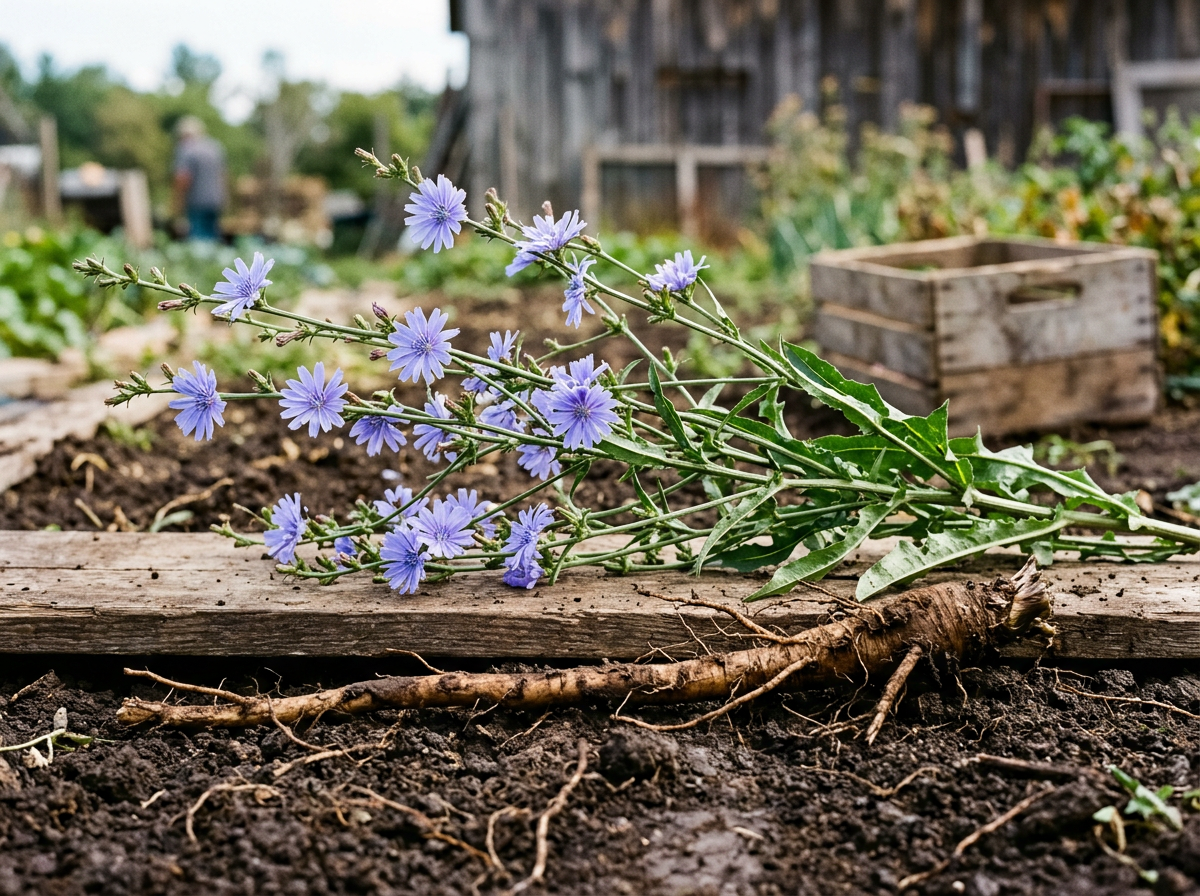
Chicory — Cichorium intybus. The blue-flowered dandelion cousin whose roasted taproot became South Africa's national coffee companion.
Chicory is not a coffee bean. South Africa's own regulations define it as the powder produced by roasting and grinding the cleaned, dried roots of Cichorium intybus — a blue-flowered relative of the dandelion. Roasted and ground, it makes a dark beverage that can complement coffee, and it can be drunk on its own or blended with coffee in regulated coffee-and-chicory products. It supplies no coffee-derived caffeine; in a coffee-and-chicory drink, the caffeine comes principally from the coffee portion. Its flavour depends on roast, concentration and preparation rather than being one fixed taste. France leaned on chicory during Napoleon's blockades; New Orleans made chicory coffee a cultural icon. And South Africa built a mass-market palate around it.
1895 and Alexandria — the Eastern Cape story
Agricultural economist Wandile Sihlobo records that commercial chicory production was introduced in the Alexandria area of the Eastern Cape in 1895, and that Alexandria has remained the centre of the industry, with pockets elsewhere. I'm citing that as an attributed historical account from a single credible source rather than a settled, multiply-corroborated date — commercial cultivation beginning in 1895 is a narrower claim than "chicory first arrived in 1895," and worth keeping precise. By the same account, it's a long-established but shrinking crop, with production falling markedly over the 2010s as planted area declined.
Ricoffy, Frisco and Koffiehuis — reading the actual labels
Rather than repeat percentages that circulate online, here's what the current packs on South African shelves in August 2026 actually say.
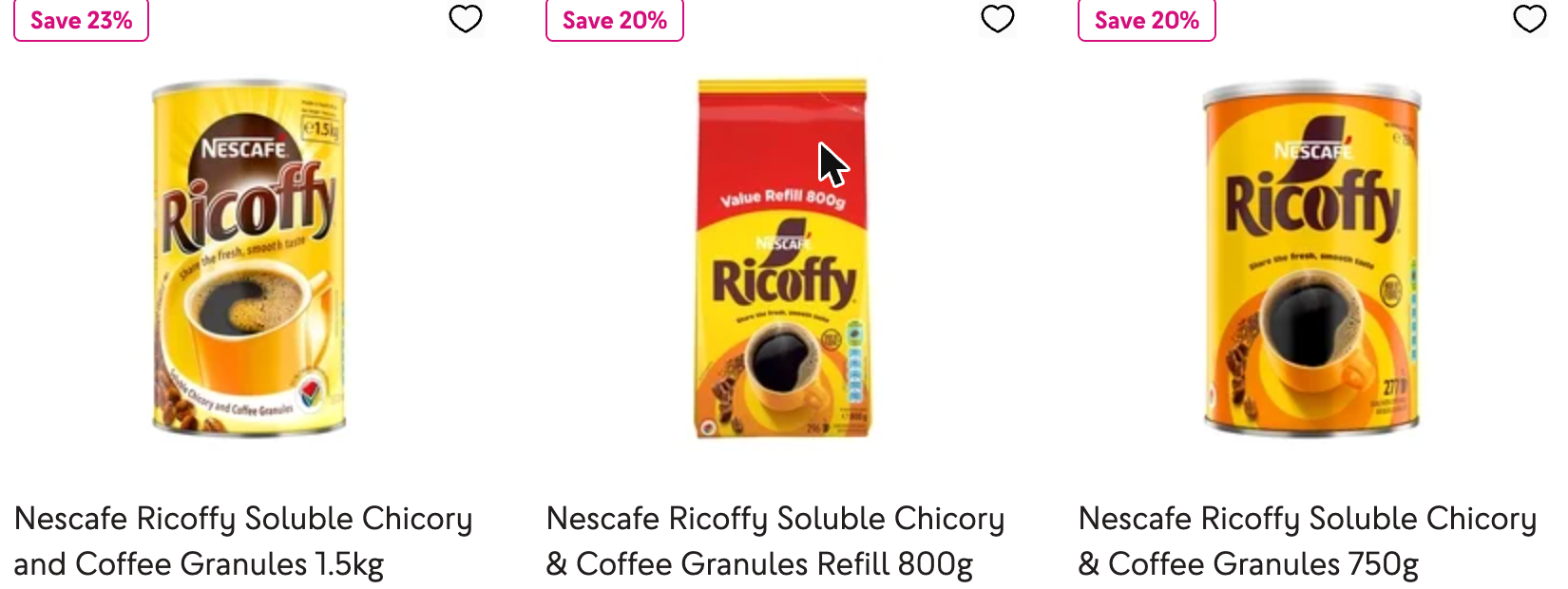
Ricoffy today: the 1.5 kg tin, 800 g refill and 750 g tin. The front of pack reads "Chicory and Coffee Granules" — chicory named first.
![Close-up of a Ricoffy ingredients panel reading: "Glucose Syrup, Chicory and Coffee mixture [Chicory (61%), Coffee (39%)]."](/articles/ricoffy-ingredients-label.png)
Straight off the pack examined in August 2026, the ingredient list read: "Glucose Syrup, Chicory and Coffee mixture [Chicory (61%), Coffee (39%)]."
Two things are worth reading carefully here. First, glucose syrup is listed before the chicory-and-coffee mixture, and ingredients are listed in descending order by mass — so glucose syrup, not the coffee, is the single largest listed ingredient. Second, the "61% chicory, 39% coffee" figures describe only the chicory-and-coffee mixture portion, not the whole tin. The pack doesn't print a single "this much coffee overall" number, so I'm not going to invent one — figures of "around a quarter coffee" get repeated online, but they're a calculation, not something declared on the label. What the label does tell you plainly: this is a chicory-and-coffee product in which chicory outweighs coffee, sitting behind a sugar.
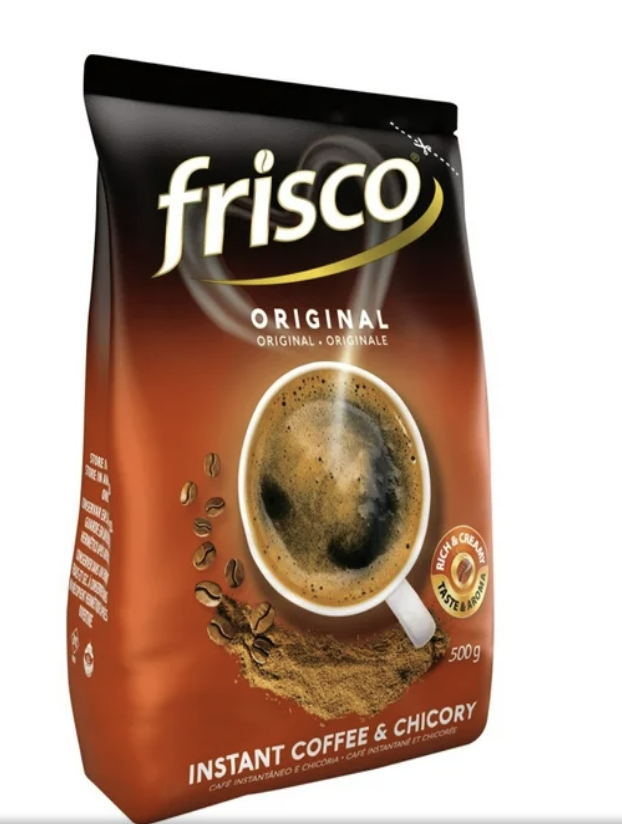
Frisco Original states it on the front: "Instant Coffee & Chicory."
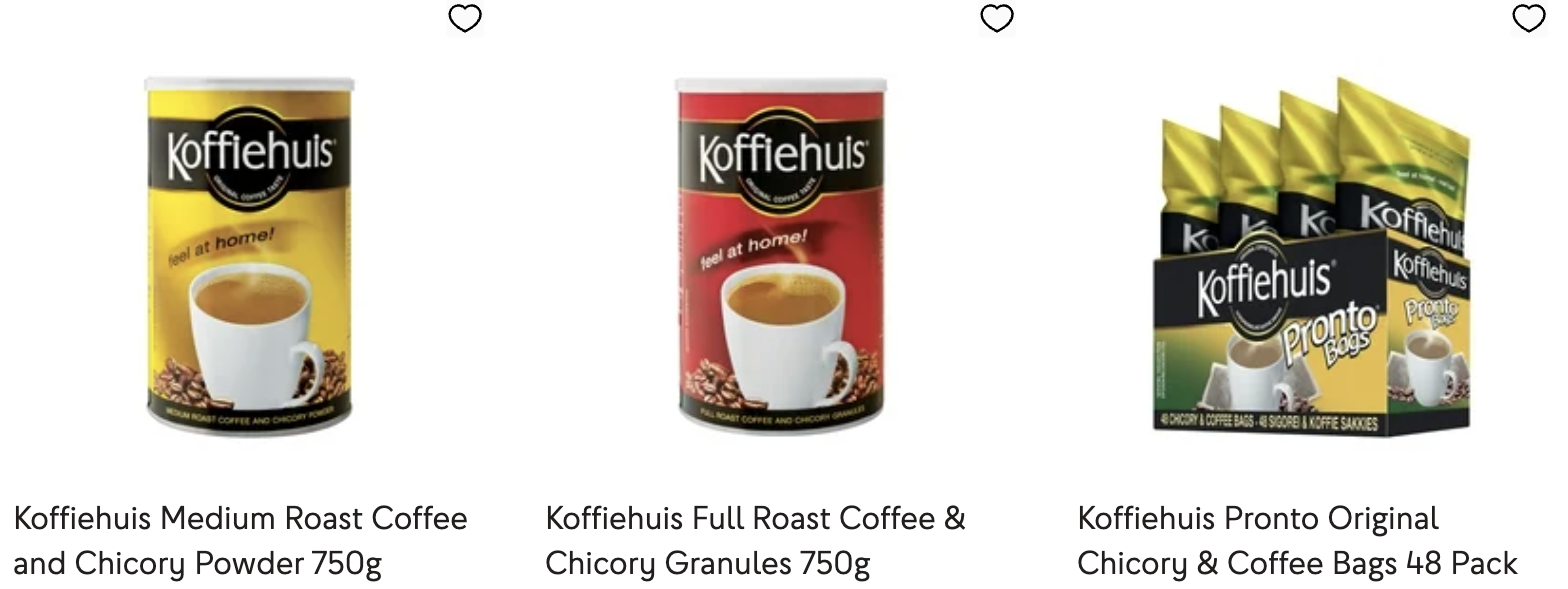
Koffiehuis across formats — powder, granules and "Pronto" bags — each named as a coffee-and-chicory (or chicory-and-coffee) product on the front of pack.
Frisco and Koffiehuis say the same thing in their own words on the front of the pack. I'm not putting exact coffee/chicory percentages to either, because I haven't verified a current, manufacturer-declared breakdown for them — and, as you'll see next, the order of the words on these labels is itself a regulated signal.
What the words on a South African coffee label legally mean
South Africa's coffee, chicory and related-products labelling regulations were gazetted on 30 October 2020 and came into operation twelve months later. They don't declare any of these products "fake" — they create separate, legally recognised categories, and the naming is deliberate:
| Regulated category | Key requirement |
|---|---|
| Ground coffee | Must contain no chicory |
| Mixed coffee / coffee mixture | At least 75% ground coffee |
| Coffee and chicory mixture | At least 50% ground coffee |
| Chicory and coffee mixture | At least 50% chicory |
| Instant coffee and chicory | Extract made from the regulated coffee-and-chicory mixture |
| Instant chicory and coffee | Extract made from the regulated chicory-and-coffee mixture |
The order of the words carries the meaning. "Coffee and chicory" means coffee is the larger or qualifying component under the applicable category; "chicory and coffee" means chicory forms at least half of the relevant mixture; and "instant coffee" is a separate category from both. So a brand name on the front of the tin shouldn't replace reading the formal product description and ingredient list — which is exactly why the word order on a Ricoffy or Koffiehuis label is the honest place to look.
Is chicory coffee "real" coffee?
The accurate answer isn't "technically, no." It's that these products belong to their own regulated categories. A chicory-and-coffee beverage isn't pure instant coffee, but that doesn't make it undefined or fraudulent — South African law expressly recognises instant coffee, instant coffee and chicory and instant chicory and coffee as distinct product names. The most accurate description of any given tin comes from the formal product name and ingredient list printed on the current pack, not from a brand's reputation or an internet argument.
And culturally, the "is it real coffee" question rather misses the point. There's good evidence the chicory habit runs deep: a 2005 University of Pretoria study (Geel, Kinnear & De Kock, in Food Quality and Preference) investigated the sensory role of chicory in local coffee products and showed that coffee-and-chicory blending was already firmly established. That research is more than two decades old, so it shouldn't be treated as a current national market-share figure — but it captures something real. For much of living memory, the everyday South African cup has leaned on chicory. That's not a scandal; it's a taste millions of us grew up on, and no barista's raised eyebrow changes what your grandmother's kitchen smelled like.
Moerkoffie — boiled coffee and the meaning of "moer"
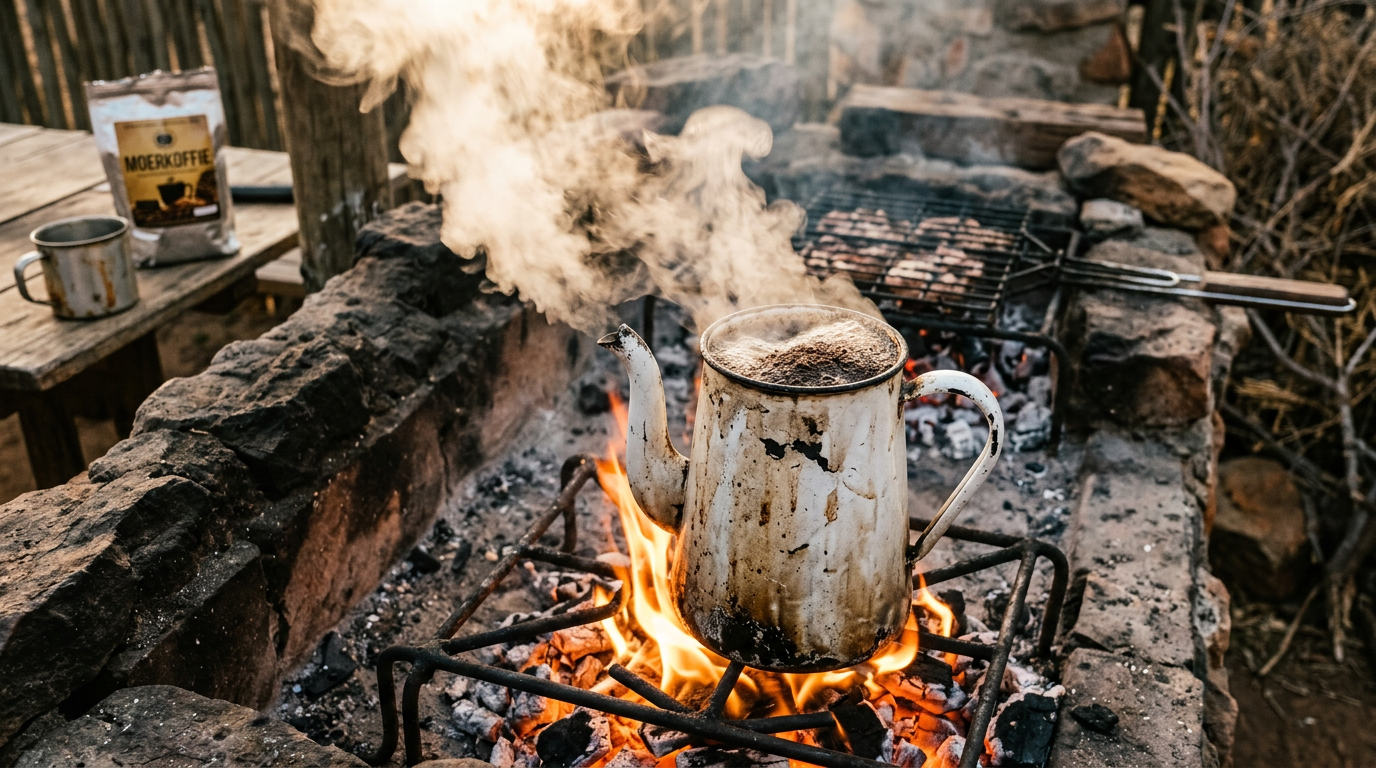
Moerkoffie: coarse grounds boiled over the coals, settled with a splash of cold water, poured so the moer stays behind.
What "moer" really means
Moerkoffie is coffee made by boiling the grounds rather than passing water through a modern filter or espresso machine. The Dictionary of South African English defines moer koffie as exactly that, and derives it from the Afrikaans moerkoffie — moer meaning the dregs or sediment, plus koffie. So the name is descriptive: it's coffee named for the layer of grounds that settles at the bottom of the pot. (The authoritative source supports that Afrikaans meaning; I'm not going to tack on a longer Middle-Dutch origin story that the reference doesn't actually establish.)
Trekboer coffee — boiled over the coals
The method is simple and old: coarse grounds boiled in a pot or enamel kettle over coals, settled with a splash of cold water, poured carefully so the moer stays behind. Strong, unfiltered, unapologetic — closer to Turkish coffee or a French press than to anything a pod machine makes. It has a deep place in South African farm and outdoor culture. I'll stop short of calling it "the original South African brew" or crediting one group with inventing it, because I haven't got the historical evidence to make a first-or-origin claim stand up — but as a living tradition it's very much still with us.
Where to find real moerkoffie today
Moerkoffie never disappeared — it lives on at padstalle, farm kitchens and braai fires, and a handful of cafes still make it properly. You can also browse the directory of South African coffee shops to find places that still serve it.
Arabica vs robusta vs chicory — which should you drink?
This is a question of preference, not hierarchy:
- For fruitier, more aromatic profiles: reach for arabica, freshly roasted and freshly ground. (See the taste-tested best coffee beans in South Africa.)
- For intensity, body and more caffeine per rand: canephora-forward blends earn their place — and they're the backbone of a thick espresso crema.
- For familiar, roasted, everyday character: a coffee-and-chicory blend is its own thing, and there's no shame in loving it. Just read the label so you know what's in the cup — and when you're curious about the coffee end of the spectrum, start with a soft single-origin arabica. (A coffee subscription is an easy way to start.)
- For a bit of both: blends exist precisely because plenty of people enjoy the combination.
FAQ
What is the difference between arabica and robusta? Arabica often tastes sweeter, more acidic and fruitier, with lower caffeine (commonly cited around 1–1.5%). Robusta — Coffea canephora — is typically more bitter and earthier with a heavier body and roughly double the caffeine. These are broad tendencies, though: origin, cultivar, processing, roast and brewing can matter as much as species, and both low- and high-quality canephora exist.
Which has more caffeine, arabica or robusta? Robusta generally has substantially more — often around twice as much as arabica. The figures usually quoted are roughly 2–2.7% for robusta versus 1–1.5% for arabica, but the exact amount varies by cultivar and product.
What is chicory coffee? Chicory coffee is made by roasting and grinding the root of the chicory plant (Cichorium intybus) and drinking it on its own or blended with coffee. It's caffeine-free on its own and adds a dark, roasted character. Historically it spread because it stretches coffee and lowers cost.
Why does South African coffee like Ricoffy and Frisco taste of chicory? Because chicory is a major, named ingredient. These are regulated coffee-and-chicory (or chicory-and-coffee) products — the front of a Ricoffy pack reads "Chicory and Coffee Granules," with chicory named first. Chicory has been farmed in South Africa since the late 1800s, and the habit is long-established.
What is moerkoffie? Moerkoffie is South African coffee made by boiling the grounds in a pot over a stove or fire. "Moer" is Afrikaans for the dregs or sediment — the grounds that settle at the bottom. It's brewed strong and unfiltered, and poured so the sediment stays in the pot.
Is Ricoffy actually coffee? It isn't the same category as pure instant coffee. South African regulations separately recognise instant coffee, instant coffee and chicory, and instant chicory and coffee — and the most accurate description of any tin comes from the formal product name and ingredient list on the current pack. A chicory-and-coffee drink is a legally defined product in its own right, not a fake; for millions of South Africans, that's exactly the point.
Sources & method
Claims above are grouped by the kind of evidence behind them, in keeping with this journal's data-integrity rules:
- Government regulations: South Africa's coffee, chicory and related-products labelling regulations — gazetted 30 October 2020, into operation twelve months later — for the category definitions and the 75% / 50% thresholds.
- Peer-reviewed / review research: a systematic review of arabica vs canephora quality factors (for the "species is only one factor" point); Geel, Kinnear & De Kock (2005), Food Quality and Preference, University of Pretoria (cited only as a 2005 finding that coffee-and-chicory blending was already established — not as a current market share).
- Consumer-market data: Eighty20's MAPS research as reported (survey of 20,000+; ~19.8 million daily instant drinkers, ~1.4 million daily ground-coffee drinkers, more than half reaching for Ricoffy). The "76% prefer instant" line is attributed to a later brand-manager interview, not treated as official.
- Dictionary research: Dictionary of South African English for the definition of moer koffie and the Afrikaans moer (dregs/sediment).
- Historical secondary source: Wandile Sihlobo for the 1895 Alexandria commercial-chicory account and production-decline context (single credible source, attributed as such).
- Product-label inspection: current Ricoffy, Frisco and Koffiehuis packs examined in August 2026 — front-of-pack product names and, for Ricoffy, the ingredient list "Glucose Syrup, Chicory and Coffee mixture [Chicory (61%), Coffee (39%)]." No whole-product coffee percentage is published on the pack, so none is asserted here.
More about who I am and how I research this journal.