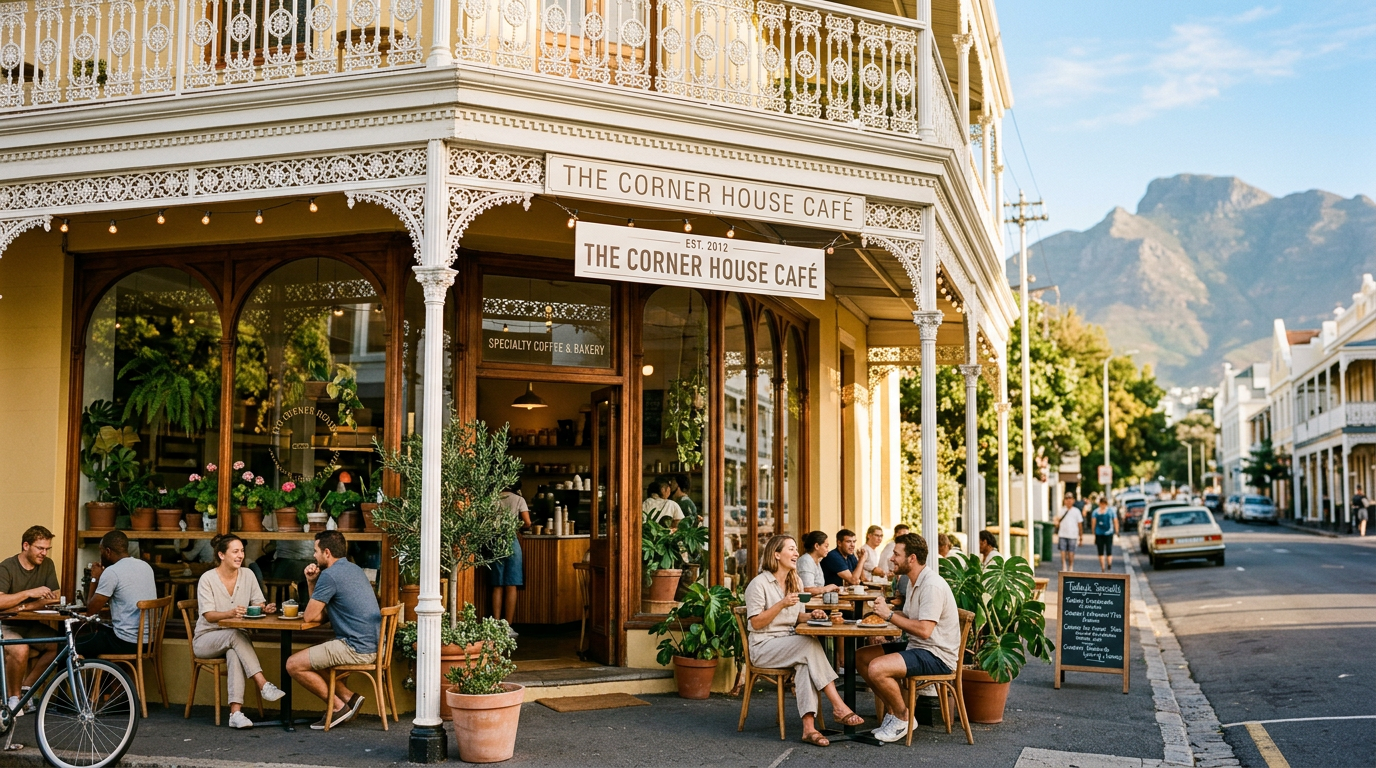
The Real Economics of Owning a Café in South Africa: What That R45 Flat White Actually Pays For
Between half and three-quarters of independent cafés close within five years. Here's an honest, South African breakdown of what it costs to open the doors, what a R45 flat white really earns, and why you're selling a room, not coffee.
Opening an SA café costs R500,000–R1.5 million, and on a R45 flat white the owner keeps under R8 once VAT, staff, rent and card fees are paid. A well-run shop nets about 10% — income, not wealth. You are really selling a room, not coffee.
So you want to open a coffee shop. A corner spot on Kloof Street or 4th Avenue in Parkhurst, plants in the window, a proper machine behind the counter, regulars who know your name. Before you sign a lease, read this.
Here's the uncomfortable truth the coffee dream leaves out: internationally, somewhere between half and three-quarters of independent coffee shops close or change hands within their first five years, and roughly one in six doesn't survive its first year. South Africa is no kinder — we just add load shedding, a 15% VAT bite and armed response fees to the list.
That failure rate doesn't happen because café owners are stupid. It happens because a café looks completely different from the outside than it does from behind the counter. What looks like a cosy room full of people sipping cortados is actually a property deal, a staffing operation, a logistics chain and a psychology experiment — all wrapped in a building that smells like espresso. The coffee itself is almost beside the point.
What it actually costs to open the doors
A small independent café in South Africa — 80 to 120 square metres, sit-down seating, proper espresso bar — will realistically cost R500,000 to R1.5 million to open. Want proof that's not exaggerated? Look at what the franchises charge, because they've done this maths hundreds of times: Vida e Caffè comes in at R950,000 to R1.4 million, Bootlegger at R2–3 million, and a sit-down Mugg & Bean at R3.69 million. Even a small express/kiosk format starts around R250,000 to R750,000.
The number that surprises everyone is the build-out. Most empty retail spaces were never designed to be cafés. No floor drains. No grease trap. An electrical DB board that can't handle a commercial machine's draw. No extraction that will pass a municipal inspection. If the previous tenant was a cellphone repair shop, you're building a small commercial kitchen inside their old walls — and the City's health department signs off on every centimetre of it before you get your Certificate of Acceptability.
A rough opening budget looks like this: deposit plus first and last month's rent (R60,000–R200,000 depending on the area), espresso machine, grinders and brewing kit (R120,000–R350,000), shopfitting, furniture and signage (R150,000–R500,000), POS system, Wi-Fi and sound (R25,000–R60,000), CIPC registration, health permits, licences and lease legal fees (R15,000–R40,000), opening stock (R40,000–R80,000), and — because this is South Africa — backup power. An inverter and battery setup big enough to keep the machine, fridges and lights running through Stage 4 will set you back R60,000–R150,000. A café that goes dark when the grid does earns nothing, twice a day.
Then the killer: working capital. You need R150,000–R400,000 in reserve to cover three to six months of losses while foot traffic builds. Most first-time owners skip this. They blow everything on a beautiful interior and a gorgeous machine, then discover in month three that they can't make payroll. That's how a café with brilliant coffee and a full house on Saturdays still closes before its first birthday.
Location: why the expensive corner is usually the cheap option
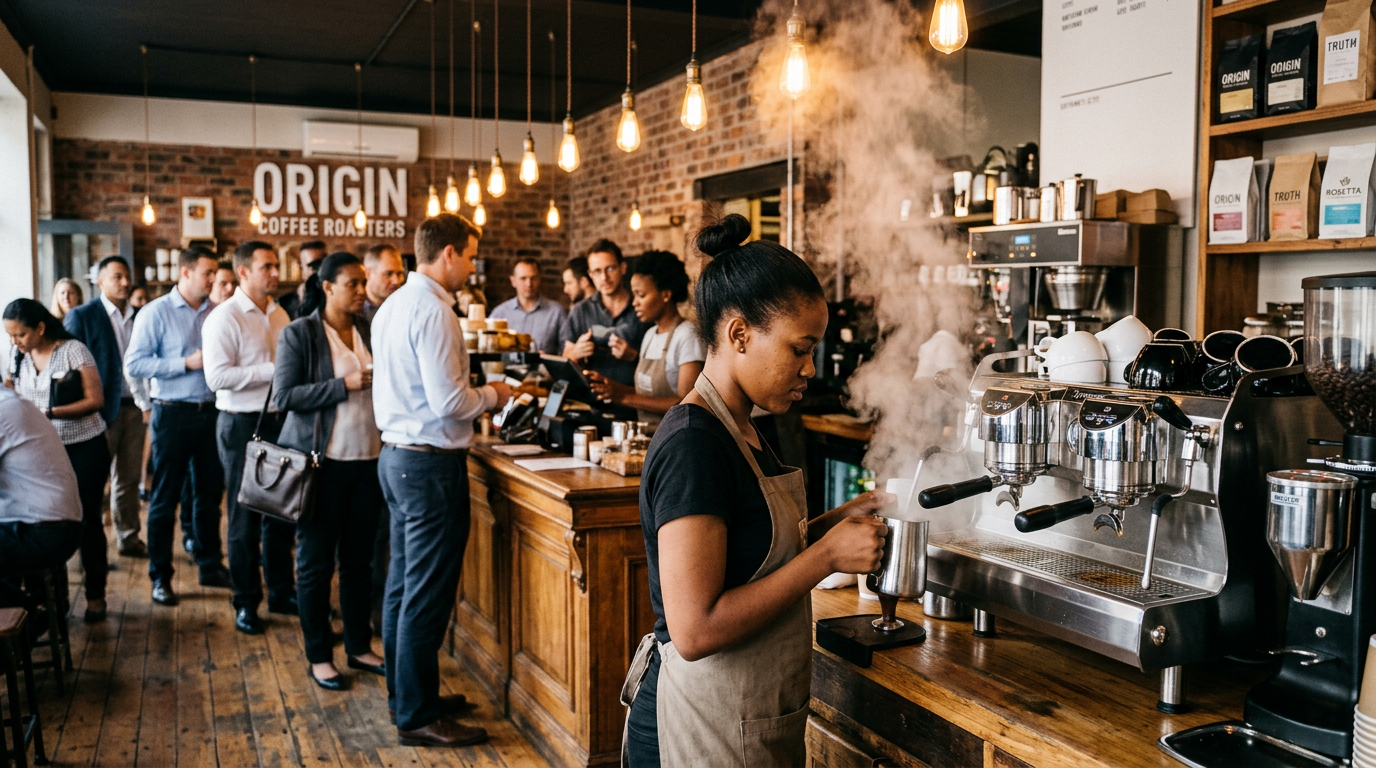
The single most important financial decision you'll make isn't the beans — it's the ground you put the café on.
A corner on Bree Street, 4th Avenue Parkhurst, Florida Road in Durban or Rosebank's strip will cost dramatically more per square metre than a spot two blocks away. And paying more is almost always the right call. Every customer a busy street delivers — because they smelled the espresso, saw the queue through the window, walked past your sign — is a customer you didn't have to pay Meta or Google to acquire. A high street site is a built-in customer acquisition machine. You're pre-paying for foot traffic in your rent.
The cheap spot in the quiet side street gives you none of that. Every customer must be pulled in through marketing, which costs money, or word of mouth, which costs time. If daily foot traffic can't cover rent and payroll, no lease saving will rescue you.
The benchmark experienced operators use: total occupancy cost should be 6–10% of projected annual turnover. Planning on R300,000 a month in sales? Your ceiling is roughly R18,000–R30,000 a month in rent. That won't get you prime Sea Point frontage — but it tells you exactly what revenue you'd need to justify it.
Also know your area's rhythm. Sandton and the Foreshore print money on weekday mornings and die on weekends. Parkhurst, Melville and Durban North give you steady seven-day neighbourhood traffic at lower average spend. Stellenbosch is a university feast that goes silent over holidays. The V&A and Franschhoek deliver endless new tourists with deep pockets — and near-zero repeat business. Your whole operating model must be built around whichever rhythm you choose.
The machine, the water, and the load shedding tax
A professional two-group espresso machine — the kind that survives a real morning rush — costs R80,000 to R250,000 in South Africa. Add two or three grinders at R15,000–R45,000 each and proper water filtration at R15,000–R35,000 and you're at R150,000+ before a single shot is pulled.
That filtration line isn't optional. Espresso is 98% water, and municipal water — especially in hard-water areas of Gauteng — carries dissolved calcium and magnesium that crystallise inside the boiler as scale. Untreated, scale will quietly murder a R200,000 machine in 12 to 18 months. A proper reverse osmosis system is the cheapest insurance policy in the building. (If you want to go deeper on why water makes or breaks a cup, I've written about that too.)
Budget R8,000–R25,000 a year for preventive maintenance — gaskets, shower screens, burrs, solenoids. Because if the machine dies on a Thursday morning with no service contract, your café earns nothing while rent runs and staff still get paid. The machine is not equipment. It's the engine.
The R45 flat white, dissected
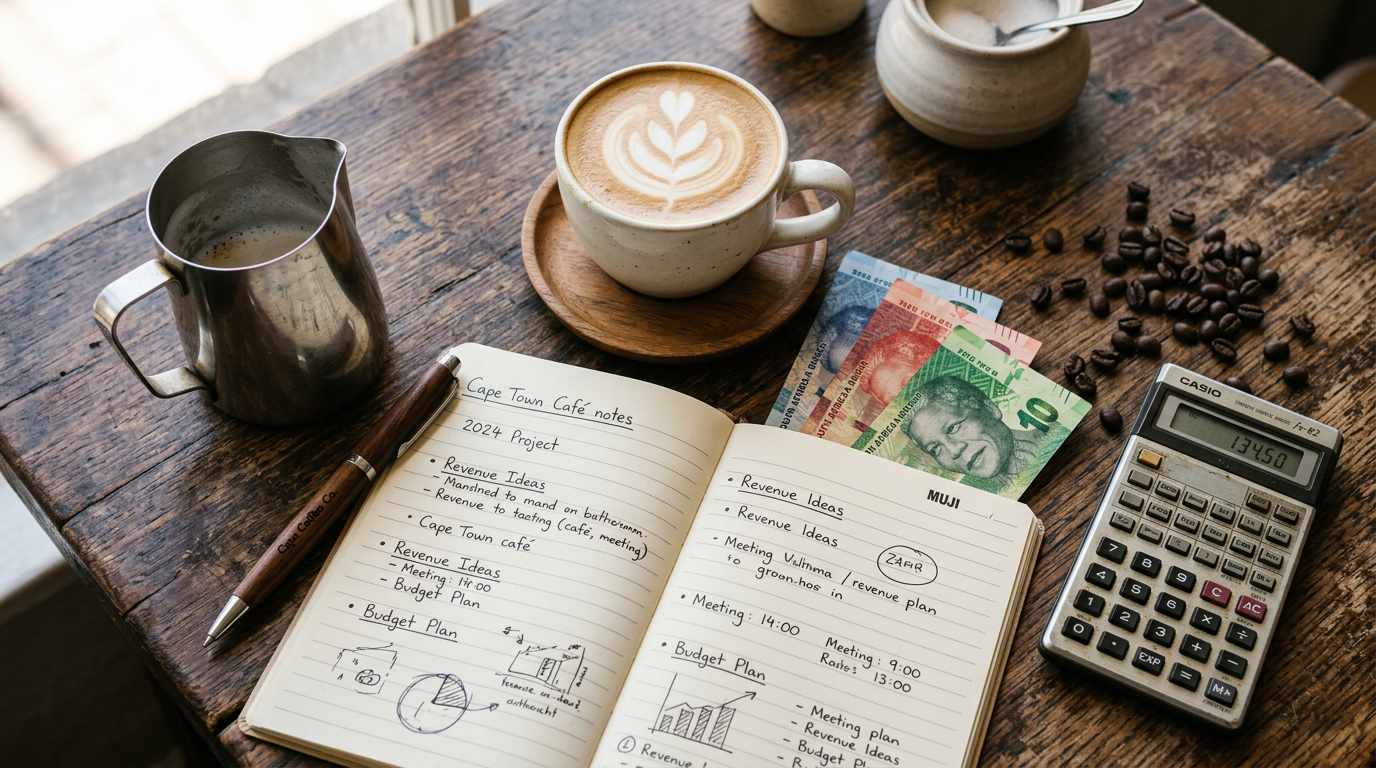
Walk into a specialty café in Cape Town or Joburg and a flat white costs R40–R55. Call it R45. The raw ingredients — an 18g dose of specialty beans at around R320/kg wholesale (R5.80), 150ml of steamed milk (R3.30), takeaway cup and lid (R2.50) — come to about R11.60. Spend eleven rand, sell for forty-five. Sounds like a licence to print money. Here's why it isn't.
First, SARS takes its slice before you count anything: that R45 includes 15% VAT, so your actual revenue is R39.13.
Then the real costs arrive, allocated per drink across a normal trading day: barista labour (R8.50), rent share (R4.00), electricity, water and the diesel-or-battery load shedding tax (R2.50), card fees at roughly 2.6–3% through Yoco or your bank (R1.20), equipment depreciation and maintenance (R1.60), insurance, licences, security and waste (R2.10).
Total cost: about R31.50. Which leaves the owner roughly R7.60 per flat white — a 17% net margin on a well-run transaction. To cover the fixed overheads of a typical small café, you need around R7,000–R8,000 in sales every single day the doors are open.
You're not selling coffee. You're selling a room.
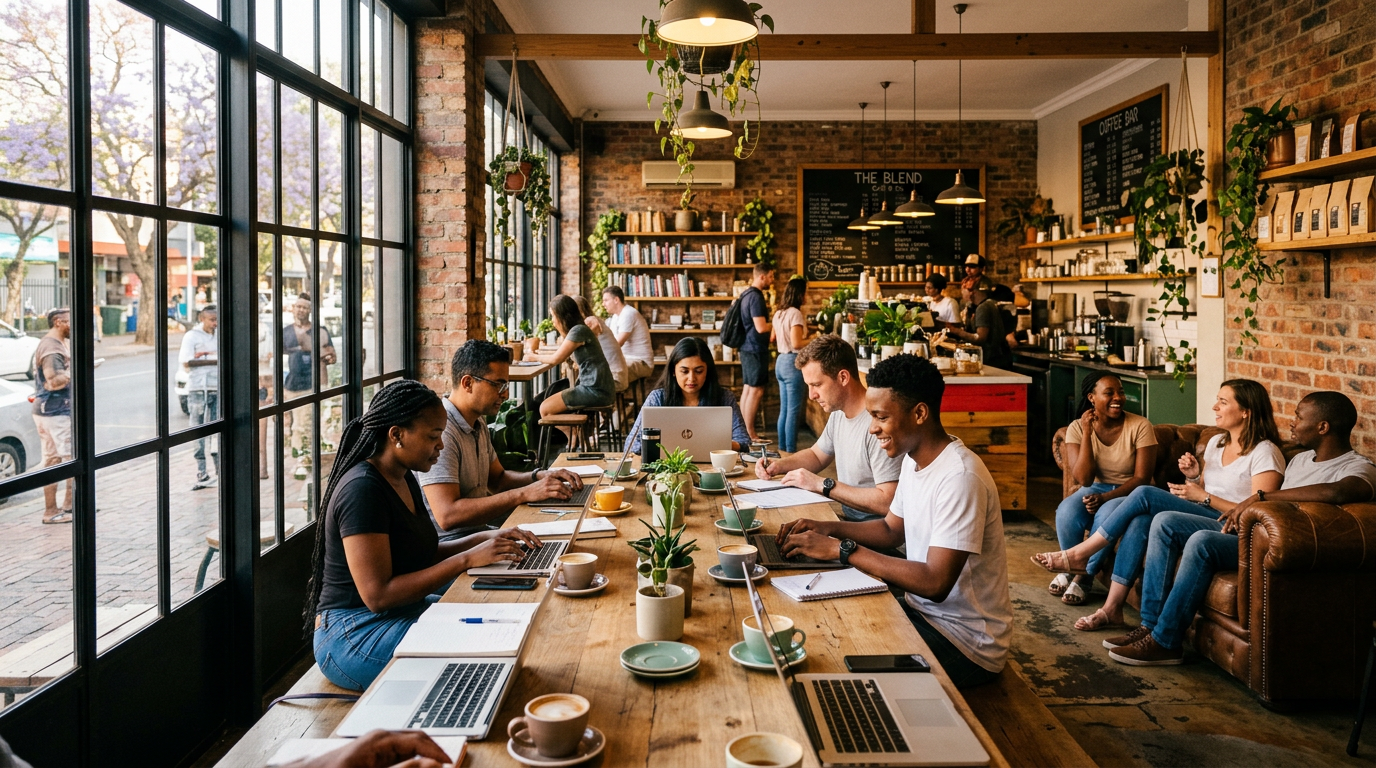
The sociologist Ray Oldenburg called it the "third place" — somewhere that isn't home and isn't work, where people can simply exist comfortably. In South Africa, the café has taken that role over from the corner shop and the club. Your customer isn't buying caffeine; they're renting a chair in a room with good acoustics, fast uncapped Wi-Fi, a socket within reach, and a bathroom they trust. They'll happily pay R45 for a drink they could make at home for R6 — because they're paying for the conditions you engineered.
But here's where it bites: the customer who buys one americano and occupies your four-seater window table for four hours writing their screenplay has paid you R35 for real estate you're renting by the square metre. That table could have turned four times at R100+ a sitting. This is a spatial yield problem, and the cafés that solve it — communal laptop bars, sockets placed deliberately, Wi-Fi codes on till slips with time limits — consistently beat the ones that don't.
Food is the difference between surviving and thriving
A R45 flat white nets you maybe R33 gross before overheads. A R45 croissant from a good wholesale bakery nets similar. But the customer who buys both hands you a R90 ticket and nearly double the gross profit — for someone who was walking through your door anyway. You already paid rent for that visit.
The industry calls it the food attach rate: the percentage of drink orders that include food. A café running 40% will consistently out-earn one running 15%, even on identical coffee sales. The catch is spoilage — beans keep for months, a croissant is bin-food by tomorrow. Between expired milk, unsold pastries and training wastage, a typical café loses 2–5% of stock value monthly. Food needs daily tracking discipline, not vibes.
Staff: your biggest monthly bill
Labour absorbs 25–35% of turnover in a well-run South African café. The national minimum wage is R30.23 an hour from March 2026, and experienced specialty baristas in Cape Town and Joburg earn R5,000–R14,000 a month, with top talent commanding more — plus UIF, and increasingly, transport allowances.
Espresso can't be automated without changing what you're selling. What you can control is the roster. Every café has a predictable shape: the 7:00–10:30 rush that carries the day, the dead 14:00 lull, the fatter weekend mid-mornings. Rostering two or three baristas for the rush and dropping to one for the lull cuts total labour hours 15–20% without customers noticing. Your POS data tells you the shape — use it.
And hold onto good people. Replacing a trained barista costs R15,000–R30,000 in recruiting, training, wasted product and slow service — in an industry where annual turnover often tops 50%. Fair pay and predictable shifts are cheaper than the revolving door.
The costs nobody budgets for
Ask a first-time owner their monthly costs and they'll say rent, beans, milk, staff. Here's what they forget: card fees (1.5–3.5% of nearly every sale, invisible, thousands of rand a month), POS and accounting software subscriptions (R500–R1,500 a month), SAMRO and SAMPRA music licences — yes, playing your personal Spotify over a Bluetooth speaker in a commercial space is a copyright violation, and they do check — plus armed response and security, municipal health permit renewals, pest control, and the diesel or battery cycling costs every time Eskom sneezes. Together these quietly add R60,000–R100,000 a year to a café that never planned for them. That's the difference between a 10% net margin and a 4% one.
So what does a good café actually make?
Take a well-run independent doing R300,000 a month — R3.6 million a year, solidly mid-range for an urban SA café. Cost of goods at 28% takes about R1 million. Staff at 30% takes R1.08 million. Rent and occupancy at 9% takes R324,000. Utilities and backup power, card fees, software, marketing, insurance, maintenance and waste take roughly another R480,000. What's left is around R350,000 — a 10% net margin.
If you're also the full-time manager (almost every independent owner is), you pay yourself a market salary of R25,000–R45,000 a month from — or on top of — that. Against R800,000 to R1.5 million invested, you're looking at a three-to-five-year payback. A decent return, comparable to a small franchise or a solid dividend portfolio. But understand what it is: income, not wealth. One café pays you a middle-class salary for showing up every day. In a bad year — a road closure, a key barista poached with your regulars in tow, an R80,000 machine repair, a dead winter — the same café loses money.
How coffee money becomes real money
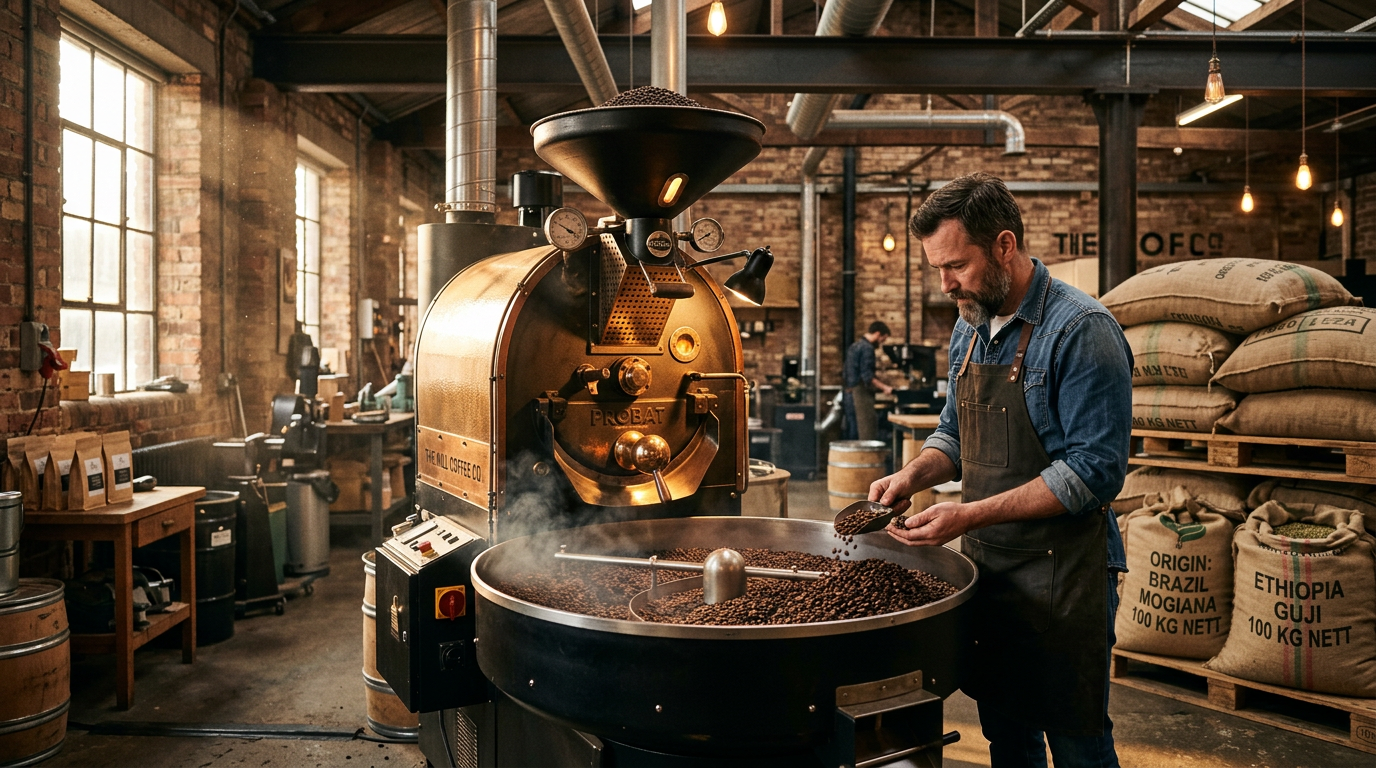
One café run well produces a salary. A scaled operation produces wealth — and South Africa keeps proving it. Vida e Caffè started as a single store on Kloof Street in 2001 and became a national chain. Bootlegger went from one Cape Town shop in 2012 to sixty-plus. Truth Coffee turned a Buitenkant Street roastery-café into a global brand.
The structural moves are always the same two. More doors: your accountant, brand, social media and admin are largely fixed costs, so a second store adds revenue without proportionally adding overhead. And roasting your own: paying a wholesaler R250–R400/kg for roasted specialty beans means funding their equipment, labour and margin. Buy green beans directly and roast in-house and you change the unit economics of every cup — then wholesale to other cafés, restaurants and offices, turning your biggest cost centre into a revenue line. (The South African roasters in my directory are almost all doing exactly this.)
The difference between the owner of one café and the founder of a coffee brand isn't better espresso. It's treating the first store as a prototype instead of the destination.
The bottom line
A café is not a coffee business. It's a property business, a labour business, a brand business and a psychology business that happens to be funded by hot drinks and pastries. On every R45 transaction the owner keeps less than eight rand. The first three to five years mostly repay the capital you put in. The failure rate is high because most people think they're buying a lifestyle and discover they've bought an operational management job with no safety net.
And yet — a well-run café in a smart location, with a trained team, a real food programme, backup power and an owner who treats it like a business rather than a passion project, can pay you reliably for twenty years. The owners who win aren't the ones pulling the best shots in the suburb. They're the ones who understand they're really selling the place people don't want to leave — and who build every operational decision around making sure leaving is the last thing anyone wants to do.
FAQ
How much does it cost to open a coffee shop in South Africa?
A small independent café of 80–120 square metres with sit-down seating and a proper espresso bar realistically costs R500,000 to R1.5 million to open. That covers deposit and rent, the espresso machine and grinders, shopfitting, POS and Wi-Fi, permits, opening stock and backup power. Franchises confirm the range: Vida e Caffè runs R950,000–R1.4 million and a sit-down Mugg & Bean around R3.69 million.
How much profit does a coffee shop make in South Africa?
A well-run independent turning over R300,000 a month typically nets around 10% — roughly R350,000 a year — after cost of goods, staff, rent and overheads. On a single R45 flat white the owner keeps about R7.60 once VAT, labour, rent and card fees are stripped out. It is a middle-class income, not wealth, and a bad year can wipe the margin out entirely.
Why do so many coffee shops fail?
Most cafés fail because owners underestimate everything except the coffee. Between half and three-quarters of independents close or change hands within five years, and about one in six doesn't survive its first year. The usual killer is skipping working capital — spending the whole budget on a beautiful interior and machine, then running out of cash in month three before foot traffic has built.
How much does a commercial espresso machine cost in South Africa?
A professional two-group machine that can survive a real morning rush costs R80,000 to R250,000. Add two or three grinders at R15,000–R45,000 each and water filtration at R15,000–R35,000, and you are past R150,000 before pulling a shot. Budget another R8,000–R25,000 a year for preventive maintenance, because a machine that dies mid-week costs you a full day's trade.
What is the biggest hidden cost of running a café?
The costs first-timers forget add up to R60,000–R100,000 a year: card fees on nearly every sale, POS and accounting subscriptions, SAMRO and SAMPRA music licences, armed response, health permit renewals, pest control and diesel or battery cycling during load shedding. On top of that sits working capital — the three to six months of reserve losses that most owners never budget for at all.
Bibi Burness is the founder of Coffee Journal, a South African specialty coffee community. He's a self-confessed coffee amateur, learning daily, bean by bean.

About the author
Bibi Burness, founder of Coffee Journal, has profiled 50+ SA specialty roasters and tested 10+ bottled water brands against the SCA standard. He completed the Bean There and Bluebird one-day home-barista courses in 2026 and maintains the site's transparency trust-score system.
Read more on the About page →