Why a South African coffee glossary?
I started keeping this list because I kept nodding along to words I did not actually understand. A roaster in Cape Town would tell me a coffee was a washed Bourbon with a 90-plus cupping score, and I would say “lovely” while having no idea whether that was a farming decision, a flavour promise, or marketing. Writing the definitions down was the only way I stopped bluffing.
South Africa also has its own coffee dialect, and most global glossaries miss it. A flat white is the default order here rather than a novelty. Bags are priced in Rand per 250g, so “cost per cup” maths looks different to the American guides. And any local definition of “temperature stability” has to survive load shedding, because a machine that needs twenty minutes to come up to heat behaves very differently when the power has just come back on.
Every definition here is written in plain language first and jargon second. If a term only matters to competition baristas, I say so, rather than making you feel behind for not knowing it. I am an enthusiast writing for other enthusiasts, not a qualified trainer, so where the specialty industry disagrees on a definition I try to describe the disagreement instead of picking a side.
How to use this glossary
The list is deliberately simple. Four things are worth knowing before you start scrolling.
- 1
Search by the word you actually heard
The search box matches both the term and the definition text, so you can type a half-remembered phrase like "grind retention" or "nine bars" and still land on the right entry. Spelling does not have to be perfect.
- 2
Filter by category when you are learning a topic
The pills split terms into Brewing, Beans, Equipment, Tasting and General. Working through one category at a time is far less overwhelming than reading A to Z, especially if you are trying to understand a single part of the process.
- 3
Follow the related terms
Most entries point at the words sitting next to them, because coffee vocabulary comes in clusters. Extraction pulls in yield, ratio and channelling. Chasing those links is usually faster than reading a whole article.
- 4
Tell me what is missing
The Suggest a Term button sends the word straight to me. Several of the entries on this page exist because a reader asked what something on a menu or a bag label meant and I could not answer it either.
Where the definitions come from
Definitions are written by me, Bibi Burness, and edited as I learn more. Where a term has an industry-standard meaning I follow the way local roasters and the Specialty Coffee Association vocabulary use it. Where the term is really a piece of kit or a technique, I describe what it does at a home setup on my Breville Barista Express, because that is the machine I actually use every day.
Some entries carry a caveat, and that is on purpose. Numbers that get quoted as gospel online, like a single “correct” brew ratio or one water recipe, are usually a starting point rather than a rule. When I have not tested something myself, the definition says what the term means without pretending I have proven it in my kitchen.
Coffee glossary questions
How many terms are in the Coffee Journal glossary?
What is the difference between a flat white and a cappuccino in South Africa?
Do I need to know these terms to make good coffee at home?
Which coffee terms should a beginner learn first?
Are these definitions specific to South African coffee?
Can I suggest a term or correct a definition?
Put the words to work
Dial in your espresso
Dose, yield and ratio stop being abstract the moment you use them to fix a sour or bitter shot.
Grind size guide
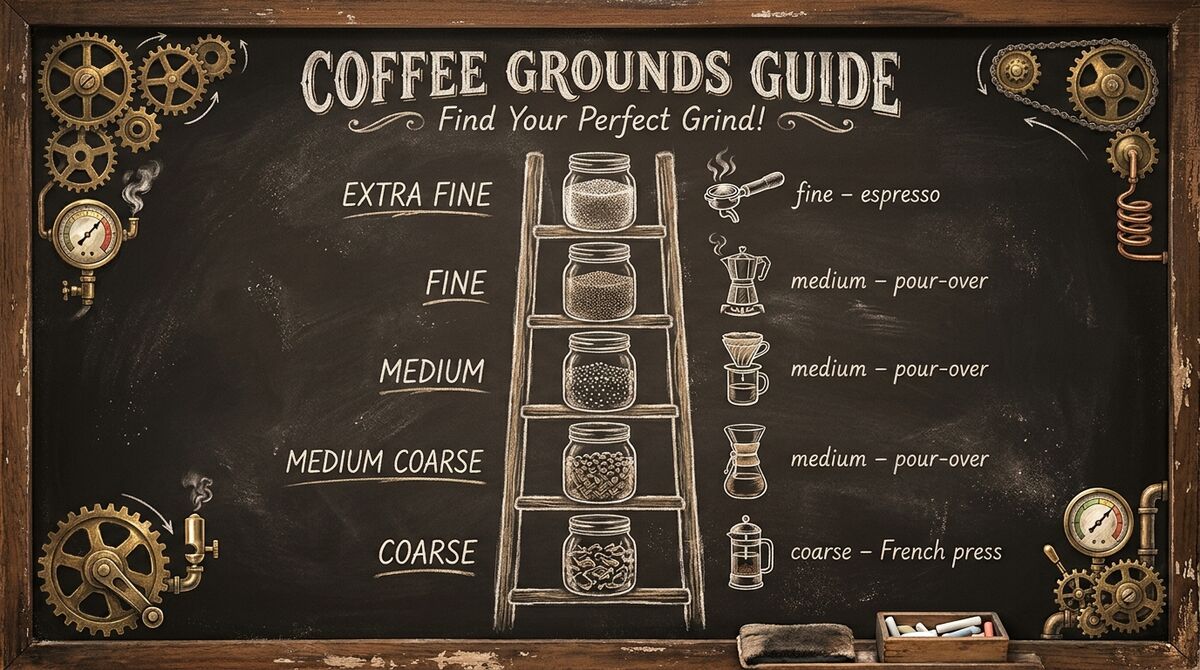
Where every brew method sits on the grind scale, with the ranges I use on my own grinder.
South African roaster directory
See the vocabulary in the wild on real bag labels from local roasters.
SA coffee price index
What specialty beans actually cost per 250g, and per cup, in Rand.