How Coffee Journal Scores SA Specialty Roasters
Our trust scoring methodology explained — the four factual criteria, how we verify them, three worked examples from the directory, and why no roaster can pay their way onto this list.
Key Takeaways
- Every roaster in our directory is assessed against four factual criteria.
- We're a small, independent project — not a certification body.
- Let me be direct: no roaster has paid to appear on Coffee Journal, and none ever will.
- The trust score is only as good as its community input.
How Coffee Journal Scores SA Specialty Roasters
South Africa's specialty coffee scene has grown faster than its vocabulary for quality. Walk into a Joburg or Cape Town roastery and you'll see the same words on every bag — single origin, artisan, small batch, specialty grade. Some of those claims are earned. Some aren't. And almost none of them come with receipts.
That's the problem Coffee Journal's Trust Score was built to address. Not to rank flavour — that's subjective and personal — but to ask a simpler, more useful question: is this roaster being transparent with you?
I'm a coffee amateur, not a certifier. I don't grade coffee for a living. But I can read a bag label, check a website, and ask hard questions in plain English. That's what this score does. It's a transparency audit, not a taste test.
The Four Criteria
Every roaster in our directory is assessed against four factual criteria. Each criterion is worth 20 points, for a maximum of 80 points from the factual audit. The remaining 20 points come from community votes (more on that below).
No criterion is weighted more heavily than another. A roaster who stamps roast dates but hides their sourcing scores the same as one who publishes SCA scores but skips the roast date. Transparency is a package deal.
1. Roast-Date Stamping
What we check: Does the roaster print a roast date (not a "best before" date) on every retail bag?
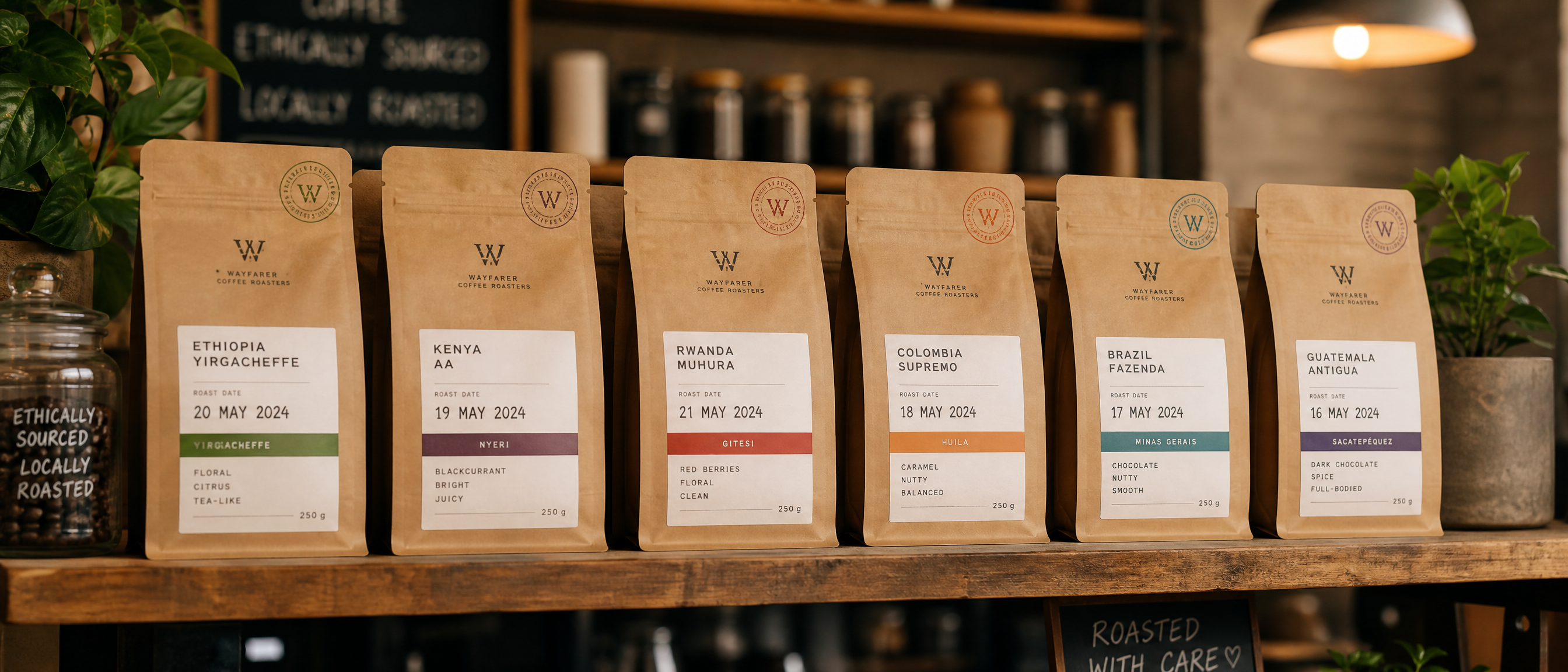
Why it matters: Coffee is a fresh product. A bag of beans roasted three weeks ago behaves completely differently from one roasted three months ago — the CO₂ has mostly degassed, the aromatics have faded, and the espresso will pour flat and bitter. A "best before" date twelve months out tells you nothing useful. A roast date tells you everything.
What earns the 20 points: A clearly printed roast date on the bag, visible before purchase. We check packaging photos on the roaster's website, their e-commerce listings, and — where possible — the physical bag.
What doesn't count: "Best before" dates, "packaged on" dates, batch codes that require a decoder ring, or roast dates buried inside sealed inner packaging you can't see until after you've paid.
2. Origin Transparency
What we check: Does the roaster disclose the origin of each coffee beyond just the country name?
Why it matters: "Ethiopian coffee" means nothing useful — Ethiopia produces everything from world-class Yirgacheffe naturals to commodity-grade Djimmah. Transparency means naming the region, the washing station or farm, the altitude where possible, and the processing method. This is the information that lets you understand what you're drinking and why it tastes the way it does.
What earns the 20 points: At minimum, country + region + processing method on the bag or product listing. Bonus credibility (but not bonus points) for naming the farm, washing station, altitude, and harvest year.
What doesn't count: Country-only labels ("Colombia"), unnamed "house blends" with no component breakdown, or vague descriptors like "African blend" or "single estate" without specifying which estate.
3. SCA Score Reporting
What we check: Does the roaster publish or reference SCA cupping scores for their coffees?
Why it matters: The Specialty Coffee Association's 100-point cupping protocol is the closest thing the industry has to an objective quality metric. A score of 80+ qualifies a coffee as "specialty grade". Publishing the score signals that the roaster has had their green beans professionally evaluated — and that they're confident enough in the result to share it.
What earns the 20 points: SCA cupping scores published on the bag, the product page, or the roaster's website for at least some of their range. We don't require every single SKU to carry a score — seasonal releases and experimental lots sometimes aren't formally graded.
What doesn't count: Self-awarded scores without third-party cupping, vague claims like "specialty grade" without a number, or scores that only appear in wholesale documentation but never reach the consumer.
4. Sustainability Certifications
What we check: Does the roaster hold or actively reference recognised sustainability certifications?
Why it matters: Fair Trade, Rainforest Alliance, UTZ, organic certification, or direct-trade programmes with published sourcing commitments all signal that a roaster is thinking beyond the cup. This criterion isn't about perfection — it's about whether the roaster has submitted to external verification of their supply chain practices.
What earns the 20 points: At least one active, verifiable certification (Fair Trade, Rainforest Alliance, USDA/EU Organic, UTZ) displayed on packaging or the roaster's website, or a published direct-trade programme with named farms and transparent pricing.
What doesn't count: Self-declared "ethical sourcing" without third-party verification, expired certifications, or logos used without a licence number.
How We Verify
We're a small, independent project — not a certification body. Our verification process is honest but limited:
Public source check. For every roaster, we review their website, online shop, social media, and — where we can get our hands on them — physical bags. We screenshot what we find. If a criterion is met, we note the source.
Direct outreach. When the public information is ambiguous, we reach out to the roaster directly — usually via email or Instagram DM — to ask for clarification. We note whether and when they respond.
Last-checked dates. Every roaster's criteria flags carry an implicit "as of" date. Coffee businesses change. A roaster might add certifications, start printing roast dates, or quietly drop a programme. We re-check periodically, and the community can flag updates via the Verify My Roaster page.
Community votes. The final 20 points come from you. Anyone can rate a roaster from 1–10 on the Verify My Roaster page. Your average score is scaled to 0–20 and added to the factual criteria. This means a roaster with a perfect 80/80 factual score can reach 100/100 if the community backs them up — and a roaster with weak transparency can still earn points if their customers genuinely trust them.
The Methodology in Practice — Three Worked Examples
Numbers are abstract. Let me show you how the score actually plays out with three real roasters from our directory.
Yellow Jacket Coffee — The Full Marks Example
Yellow Jacket Coffee is a Cape Town roastery based in Kenilworth, run by a Q-grader head roaster. Here's how they score:
| Criterion | Met? | Evidence |
|---|---|---|
| Roast-date stamping | ✅ Yes | Roast date printed on every retail bag |
| Origin transparency | ✅ Yes | Full origin detail — country, region, farm, processing method, and altitude on bag and website |
| SCA score reported | ✅ Yes | Cupping scores published on product pages |
| Sustainability certs | ✅ Yes | Direct-trade programme with named farms |
Factual score: 80/80. With community votes factored in, Yellow Jacket can reach a perfect 100. This is what transparency looks like when a roaster commits to every layer of it.
Cedar Coffee Roasters — The Mid-Score Example
Cedar Coffee Roasters is a small-batch Johannesburg roastery. They do some things brilliantly and have room to grow on others:
| Criterion | Met? | Evidence |
|---|---|---|
| Roast-date stamping | ✅ Yes | Clear roast date on bags |
| Origin transparency | ✅ Yes | Region, processing method, and farm detail on packaging |
| SCA score reported | ❌ No | No cupping scores published publicly |
| Sustainability certs | ❌ No | No formal certifications referenced |
Factual score: 40/80. Cedar does the freshness and origin work well. Adding SCA scores and pursuing certification would push them significantly higher. A 40 isn't a bad score — it means a roaster is halfway there and doing the basics right.
The Commodity Shelf — A Composite Low-Score Example
We won't name a specific roaster here, but this composite represents what we commonly find on supermarket shelves:
| Criterion | Met? | Evidence |
|---|---|---|
| Roast-date stamping | ❌ No | "Best before" date only, 12 months out |
| Origin transparency | ❌ No | Label says "Blend" or "South American" |
| SCA score reported | ❌ No | No cupping scores anywhere |
| Sustainability certs | ❌ No | No verifiable certifications |
Factual score: 0/80. Community votes could still add up to 20 points, but the factual audit finds nothing to reward. This isn't a judgement on taste — some people genuinely prefer these blends — but it's a zero on our transparency criteria.
Why This Isn't Sponsored
Let me be direct: no roaster has paid to appear on Coffee Journal, and none ever will.
This is an independent project. I buy my own coffee, I take my own notes, and the trust scores are calculated from publicly verifiable criteria. There are no paid placements, no "featured roaster" slots, and no affiliate deals with any roaster in the directory.
The community voting system is POPIA-compliant — we collect a display name and an optional comment, nothing more. No email required, no tracking, no marketing lists.
If a roaster disagrees with their score, the fix is simple: meet the criteria. Print a roast date. Publish your origins. Share your SCA scores. Get certified. The score updates automatically.
Cast Your Vote
The trust score is only as good as its community input. If you've bought from a South African roaster and have an opinion on their transparency, freshness, or quality, head to Verify My Roaster and add your voice.
Every vote counts — literally. Your 1–10 rating feeds directly into the final trust score.
Frequently Asked Questions
How often are trust scores updated? The factual criteria (roast date, origin, SCA, sustainability) are checked periodically and can be flagged for re-review by the community at any time via the Verify My Roaster page. Community vote averages update in real time as new votes are submitted.
Can a roaster request a re-assessment? Absolutely. If a roaster has started printing roast dates, publishing SCA scores, or earning certifications since we last checked, they can reach out via the site and we'll update their criteria flags.
Why don't you score flavour or roast quality? Because flavour is subjective. I might love a light, fruity Ethiopian natural that you find too acidic. The trust score deliberately avoids taste — it measures only verifiable, factual claims about transparency and sourcing practices.
What's the maximum possible trust score? A roaster who meets all four factual criteria (80 points) and has a perfect 10/10 community average (scaled to 20 points) scores 100/100. In practice, scores above 90 are rare and represent genuine commitment to transparency.
Is Coffee Journal affiliated with any roaster or certification body? No. Coffee Journal is an independent project by Bibi Burness. We have no commercial relationship with any roaster, certification body, or industry organisation. The project is self-funded and community-supported.
How is community voting protected from manipulation? We monitor voting patterns for anomalies. Bulk identical votes, suspiciously timed clusters, or votes that don't align with broader patterns are flagged for review. The community component is capped at 20/100, so even if gaming occurred, factual criteria still carry 80% of the weight.
Published by Bibi Burness · Coffee Journal SA · coffeejournal.co.za
Keep reading:

About the author
Bibi Burness, founder of Coffee Journal, has profiled 50+ SA specialty roasters and tested 10+ bottled water brands against the SCA standard. He completed the Bean There and Bluebird one-day home-barista courses in 2026 and maintains the site's transparency trust-score system.
Read more on the About page →