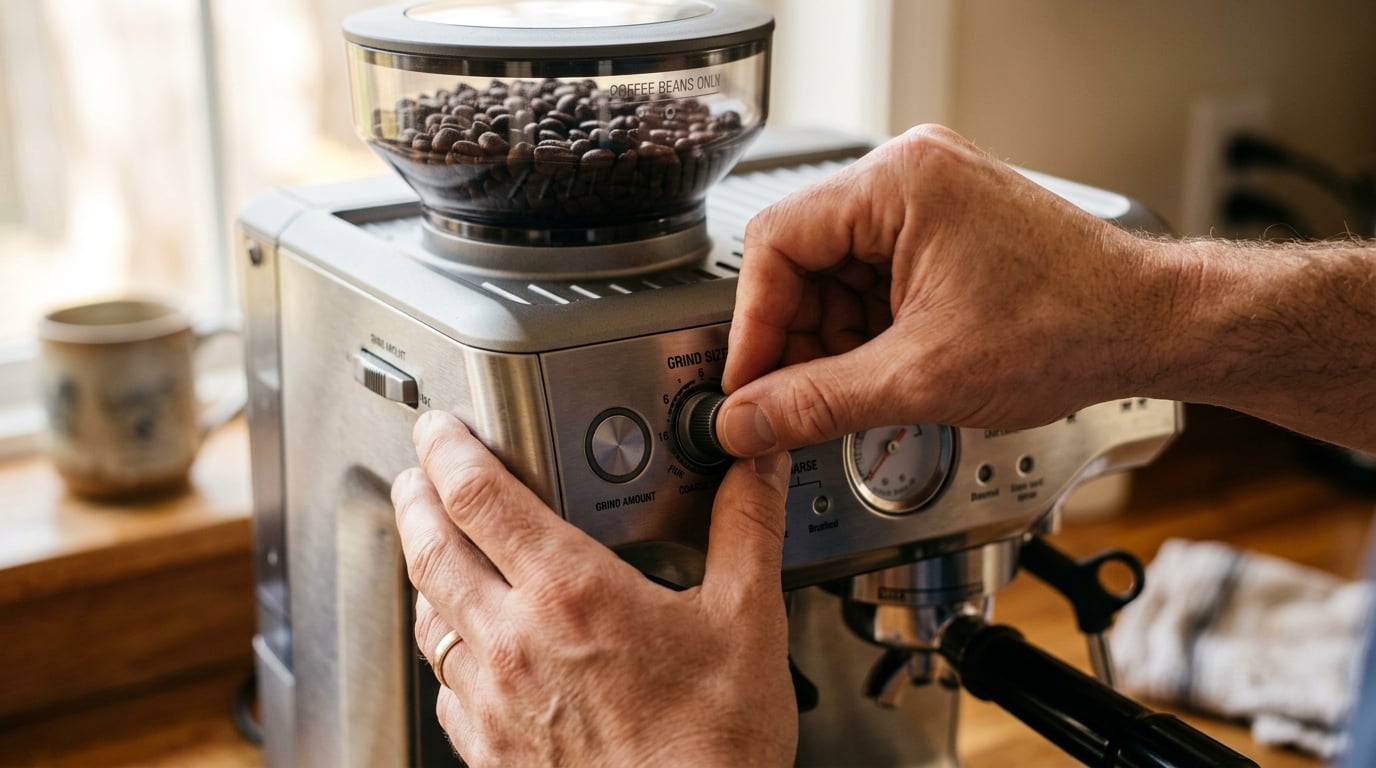
How to Dial In Your Coffee Grinder: One Rule, Clear Steps
Sour? Go finer. Bitter? Go coarser. How I dial in the built-in grinders on my Breville and Meraki for espresso and filter — plus how roast, freshness and process change everything.
Key Takeaways
- You get a new machine, make your first cup, and it tastes off — too bitter, too sour, too weak — and you’ve got no idea where to start.
- The same grinder setting almost never carries over between bags.
- Filter is more forgiving, but the same logic applies:
- Light roast, washed → start finer.
One Rule, Clear Steps
You get a new machine, make your first cup, and it tastes off — too bitter, too sour, too weak — and you’ve got no idea where to start. That exact confusion is what “dialling in” solves, and I promise it’s far simpler than the coffee forums make it sound.
Here’s the whole system in one line:
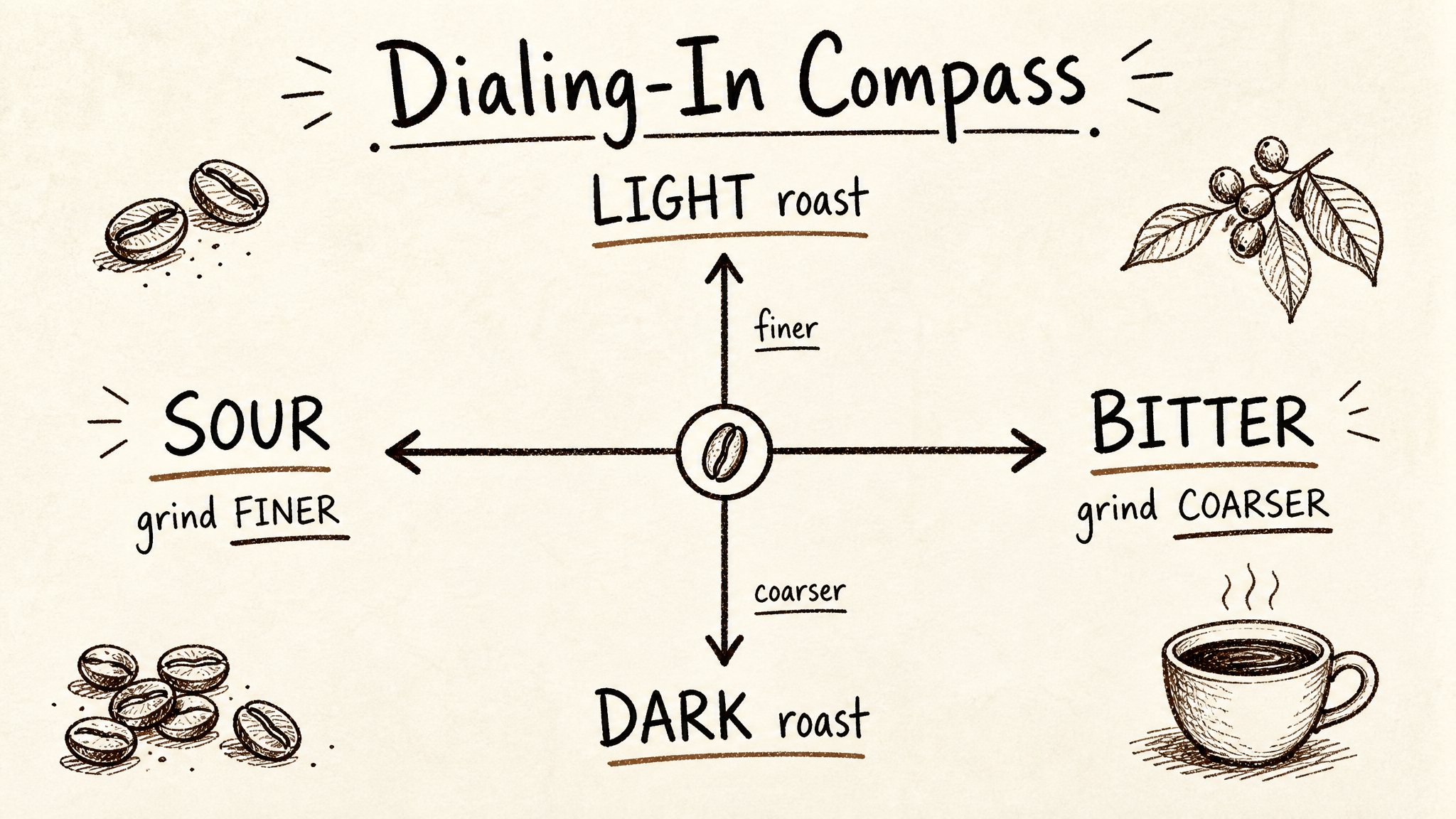
Sour or weak → grind finer. Bitter or harsh → grind coarser.
That’s it. Everything else in this guide is just knowing where to start and what nudges that starting point around. Equipment-wise you barely need anything — a grinder and a way to weigh your coffee. I do all of this on the built-in grinders on my Breville Barista Express and my Meraki, plus a cheap 0.1 g scale. You don’t need a separate boutique grinder to get a great cup.
The Three Things That Change Your Starting Point
The same grinder setting almost never carries over between bags. Three things decide where you begin.
1. Roast Level
- Light roasts are denser and harder — water struggles to get in. Start finer.
- Dark roasts are more porous and extract fast. Start coarser, or the cup turns bitter quickly.
2. Freshness
Coffee in its first two weeks off roast is still releasing CO2, and that gas pushes water away — extraction runs slower and tastes unpredictable. Go slightly coarser than you’d expect, and let a very fresh bag settle a few days.
As coffee ages the opposite happens: it extracts more easily. The setting that sang in week one can taste bitter by week four, so drift coarser as the bag gets older.
3. Processing Method
- Washed coffees are denser (fruit removed before drying) — grind slightly finer, use hotter water. Clean and straightforward to dial in.
- Natural coffees are more porous and sugar-loaded — they extract easily and can go muddy fast. Grind slightly coarser and watch your temperature.
- Honey process sits between the two — treat it closer to a natural.
Dialling In Espresso, Step by Step
- Start at: 18 g in, 36 g out, in 25–35 seconds.
- Pull the shot and taste it first — always taste before you look at the timer.
- Sour or thin, ran fast? Go finer, one or two clicks at a time.
- Bitter or dry, ran slow? Go coarser, same small steps.
- Repeat until it tastes balanced. Then write the setting down.
Two warnings from my own kitchen. A light-roast washed coffee from a high-altitude farm starts noticeably finer than a dark-roast natural — never assume your usual number carries over. And if the bag is very fresh, give it 7–10 days off roast before you dial in for espresso; gassy coffee is inconsistent and it will frustrate you.
Want the bigger picture? Here are the 6 variables behind café-quality coffee.
Dialling In Filter Coffee
Filter is more forgiving, but the same logic applies:
- Recipe: 15 g coffee to 250 g water
- Temperature: 90–96°C — hotter for light roasts, cooler for dark
- Total brew time: around 3–4 minutes
Draining too fast with a flat cup? Grind finer. Draining too slowly with a heavy cup? Grind coarser.
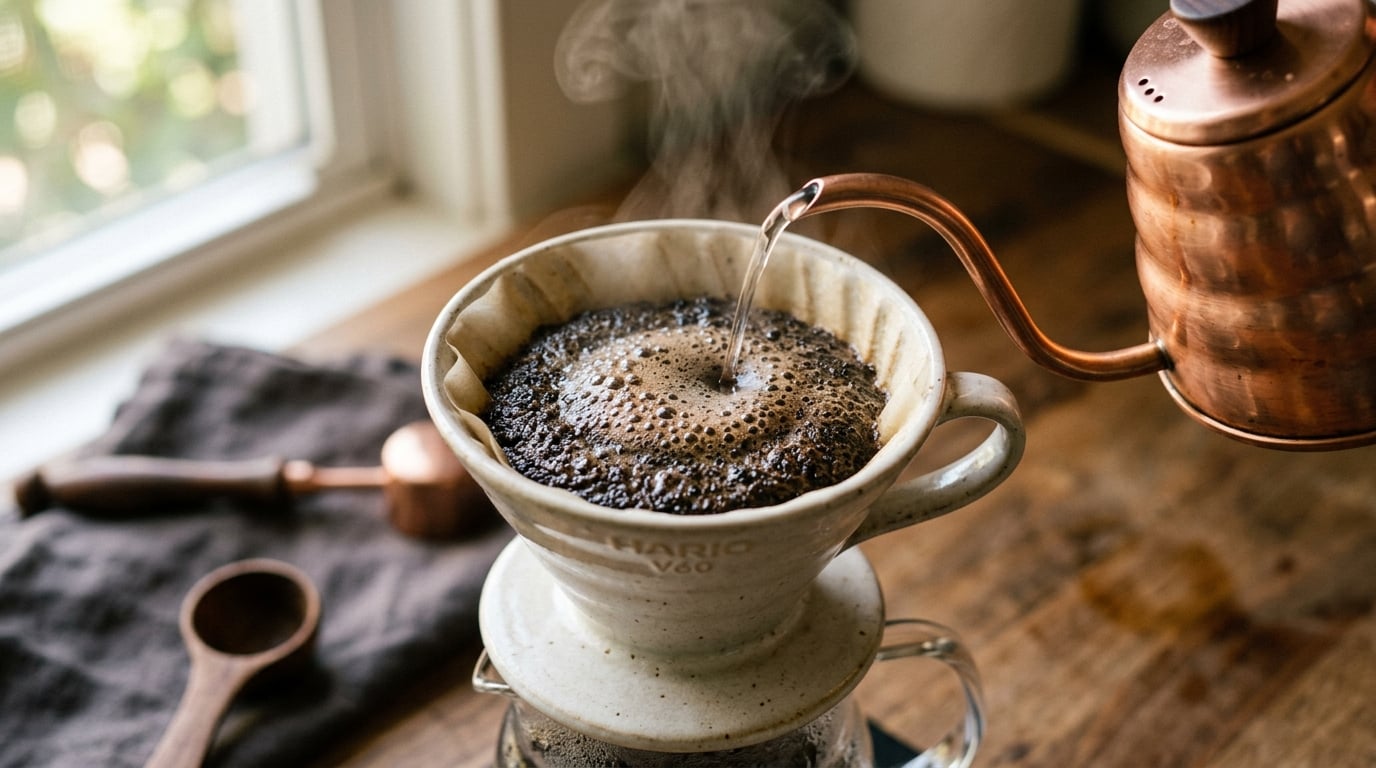
Reading the bloom: vigorous bubbling means fresh coffee — a healthy start. Barely any bloom means older coffee — go slightly finer. Dark roasts bloom aggressively early; light roasts bloom quietly but longer. Both are normal, so don’t let the bloom alone throw you.
Three Habits That Make It All Easier
- Change one variable at a time — otherwise you’ll never know what made the difference.
- Purge your grinder after every adjustment — the old grind size is still sitting in the burrs.
- Keep notes — even just a photo of your settings saves serious time on the next bag. (I log mine in the brew journal so I never start from scratch.)
Your Dialling-In Compass
Light roast, washed → start finer. Dark roast, natural → start coarser. Sour or weak → go finer. Bitter or harsh → go coarser. One variable at a time, taste after every change.
That really is all dialling in is. It stops feeling like a dark art the moment you accept that every bag is a fresh little puzzle — and honestly, solving that puzzle with a local single origin on a slow Sunday morning is half the reason I love this stuff. Don’t overthink it. Just start.
FAQ
What does “dialling in” a grinder mean?
Adjusting grind size (and dose/yield) until a specific coffee tastes balanced. Every new bag needs a small re-dial because roast level, freshness and processing all change how it extracts.
Why does my espresso taste sour?
It’s under-extracted — usually the grind is too coarse and the shot runs fast. Grind finer in small steps and taste after each change.
Why does my espresso taste bitter?
It’s over-extracted — the grind is too fine and water is stuck in the puck. Go coarser one or two clicks at a time.
How long should I wait before brewing freshly roasted beans?
For espresso, 7–10 days off roast. Very fresh coffee releases CO2 that makes extraction inconsistent and dialling in frustrating.
Do I use the same grind setting for every coffee?
Almost never. Light-roast washed coffees start finer; dark-roast naturals start coarser; and the same bag needs a coarser setting as it ages.
Bibi Burness is the founder of Coffee Journal, a South African specialty coffee community. He’s a self-confessed coffee amateur, learning daily, bean by bean.

About the author
Bibi Burness, founder of Coffee Journal, has profiled 50+ SA specialty roasters and tested 10+ bottled water brands against the SCA standard. He completed the Bean There and Bluebird one-day home-barista courses in 2026 and maintains the site's transparency trust-score system.
Read more on the About page →