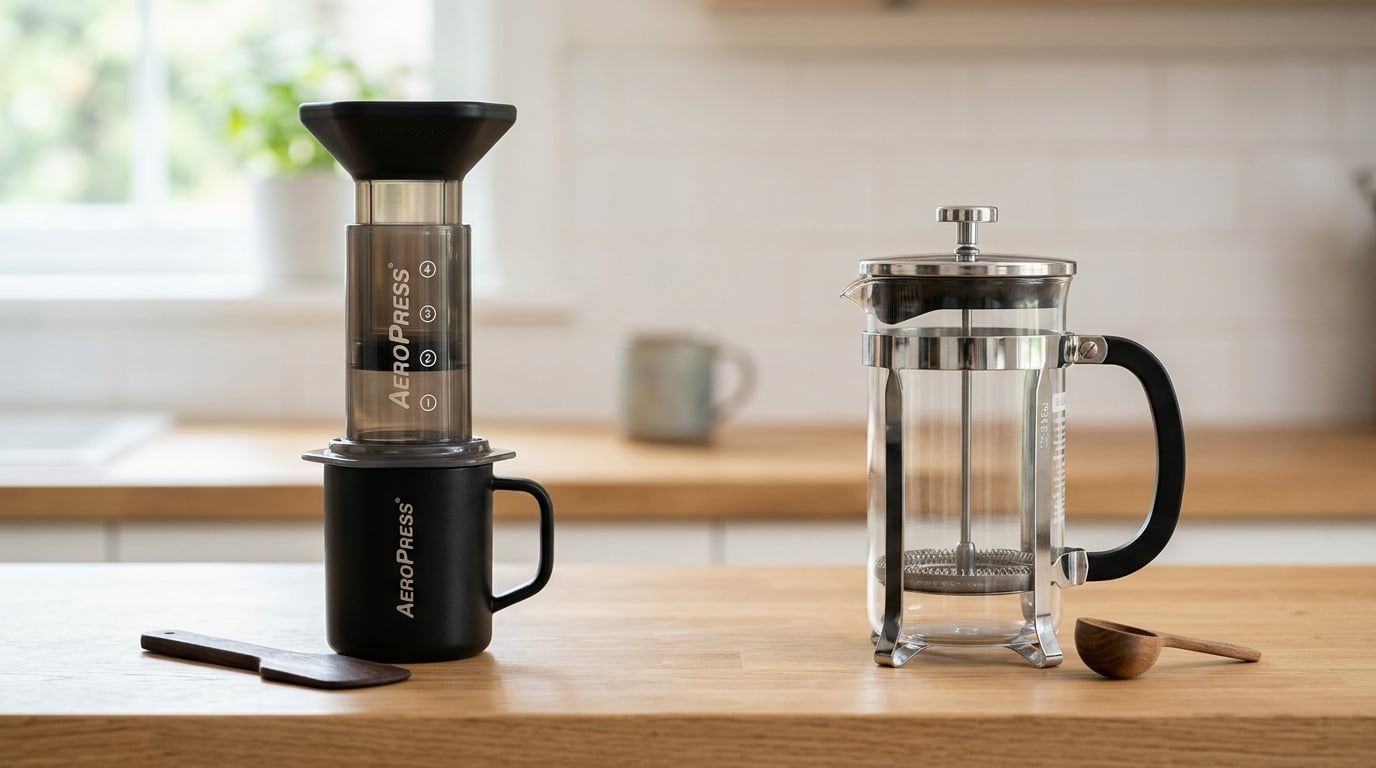
AeroPress vs French Press During a Power Outage: Which Wins?
Two of the most popular manual brewers go head-to-head for load shedding duty. We compare taste, ease, cleanup, and everything else to help you choose.
Key Takeaways
- When the lights go out in South Africa, two coffee makers rise above the rest: the AeroPress and the French Press.
- Choose the AeroPress if: You brew for yourself, value clean flavour, and want something portable.
- The AeroPress has a few steps: add coffee, add water, stir, wait, press.
- The AeroPress makes one cup at a time.
The Two Best Power-Free Brewers, Compared
When the lights go out in South Africa, two coffee makers rise above the rest: the AeroPress and the French Press. Both are affordable, both work without electricity, and both make genuinely excellent coffee. But they're very different beasts.
I've been brewing with both throughout every stage of load shedding — from Stage 2 interruptions to full-on Stage 6 marathons. Here's my honest, side-by-side comparison after hundreds of cups.
If you're looking for the full picture of power-free brewing, check out our complete load shedding coffee guide.
The Quick Verdict
Choose the AeroPress if: You brew for yourself, value clean flavour, and want something portable. Choose the French Press if: You brew for the household, prefer full-bodied coffee, and don't mind a bit of sediment.
But there's a lot more to it than that.
Taste: Clean vs Full-Bodied
AeroPress
The AeroPress produces a clean, bright cup with excellent clarity. Because it uses a paper filter, you get no sediment, no oils floating on top, and a very defined flavour profile. Light and medium roasts absolutely sing in an AeroPress — you can taste the origin, the processing method, the altitude the beans were grown at.
Single-origin beans from roasters like Rosetta Roastery or Origin Coffee Roasting in Cape Town are exceptional in an AeroPress. You'll taste tasting notes you never knew existed.
French Press
The French Press uses a metal mesh filter, which means oils and fine particles pass through into your cup. The result is a heavier, richer, more full-bodied coffee. Think chocolate, caramel, and body — lots of body. It's more forgiving with different bean types and roast levels.
Dark roast blends from Truth Coffee or Bean There are brilliant in a French Press. The full immersion brings out deep, comforting flavours.
Winner: Tie. This is purely about preference. Clean and bright vs rich and full? Neither is objectively better.
Ease of Use: Both Are Simple, But...
AeroPress
The AeroPress has a few steps: add coffee, add water, stir, wait, press. It takes about 2 minutes total. But there's a technique to it — you can adjust the water temperature, the steep time, the pressure, and even invert the whole thing (the "inverted method") for different results.
For beginners, the standard recipe is dead simple. For enthusiasts, there's a world of experimentation. The World AeroPress Championship exists for a reason.
French Press
Even simpler: add coffee, add water, wait four minutes, press the plunger down. That's it. There's really only one variable to play with (grind size), and even getting it slightly wrong still produces a perfectly drinkable cup.
During Stage 6, when I was half-asleep and fumbling by candlelight, the French Press was my go-to precisely because it required zero brainpower.
Winner: French Press. It's marginally simpler, especially when you're tired and operating by torchlight.
Capacity: One Cup vs a Crowd
AeroPress
The AeroPress makes one cup at a time. You can make a concentrated shot and dilute it, or brew an Americano-style cup, but it's fundamentally a single-serve device. If you're making coffee for three people, you're pressing three times.
During one memorable Stage 6 evening, I made eight AeroPress cups for a dinner party. It took 20 minutes. Not ideal.
French Press
A standard French Press makes 3–4 cups in one go. The big ones do 6–8 cups. Fill it up, wait, press, pour. Everyone gets coffee at the same time.
For households, for braais, for "the whole building's power is out" situations — the French Press wins hands down.
Winner: French Press, convincingly.
Cleanup: Where the AeroPress Shines
AeroPress
Pop the cap off, push the puck into the bin, rinse with water. Done. 15 seconds. The paper filter goes with the puck. There's nothing to scrub, nothing to soak, nothing to deal with. This is the AeroPress's superpower.
French Press
Oh, the French Press cleanup. The wet grounds cling to everything. You can't just tip them into the sink (they'll clog it). You need to scoop them into the bin, then scrub the mesh filter, then rinse the glass. During load shedding, when your water pressure might be low and you're working by candlelight, this is genuinely annoying.
Winner: AeroPress, by a mile.
Durability and Portability
AeroPress
It's made of tough, BPA-free plastic. It's virtually indestructible. I've dropped mine, stepped on it, thrown it in a backpack for camping trips. It still works perfectly. It also weighs almost nothing and nests neatly.
French Press
Most French Presses have a glass carafe. Glass breaks. During load shedding, when you're navigating your kitchen in the dark, this is a real risk. (Ask me how I know.) You can get stainless steel versions, but they're pricier and less common.
Winner: AeroPress. It's basically indestructible.
Cost
AeroPress
R500–R700 in South Africa. Replacement filters cost about R60 for 350 (that's roughly 17 cents per cup). The total cost of ownership over a year is very low.
French Press
R200–R400 for a decent one. No ongoing filter costs — the metal mesh is permanent. But if you break the glass, replacement carafes are R100–R200 (if you can find one that fits your model).
Winner: French Press on upfront cost, AeroPress on durability value.
Load Shedding Specifically: The Real-World Test
Here's where it gets practical. During an actual power outage:
Water heating: Both need hot water. If you've pre-boiled and stored water in a thermos, both work equally well. If you're heating water on a gas hob during the outage, the AeroPress uses less water per cup (250ml vs 280ml for a French Press), so your thermos lasts longer.
Lighting: The AeroPress is easier to use in dim light because it's a simple press-down motion. The French Press requires you to pour from a kettle into a glass container in the dark — spillage is common.
Speed: AeroPress is marginally faster (2 min vs 4 min), which matters when you're making multiple cups.
Group brewing: If it's you and your household, French Press. If it's just you, AeroPress every time.
The Verdict: Which Should You Buy?
Here's my honest recommendation after years of load shedding brewing:
Buy both. Seriously. For under R1,200 total, you get the best solo brewer and the best group brewer. Use the AeroPress for your morning cup and the French Press when guests are over.
But if you can only buy one:
- Solo brewers: Get the AeroPress. The cleanup alone is worth it.
- Families: Get the French Press. Making four cups at once is non-negotiable with kids and partners waiting.
- Camping and travel: AeroPress. It's unbreakable and packs flat.
- Flavour explorers: AeroPress. The range of recipes and techniques is extraordinary.
Recommended Beans for Each Method
For AeroPress
Light to medium roasts that highlight origin character:
- Origin Coffee Roasting (Cape Town) — Their seasonal single-origins are incredible
- Rosetta Roastery (Cape Town) — Competition-grade lots
- Quaffee (Stellenbosch) — Exceptional Ethiopians
For French Press
Medium to dark roasts with body and sweetness:
- Truth Coffee (Cape Town) — The Resurrection Blend is a French Press classic
- Bean There (Johannesburg) — Fair-trade, full-bodied African coffees
- Terbodore (Franschhoek) — Their espresso blends work brilliantly here
Browse our full SA Roasters directory for more options.
Final Thoughts
Load shedding took a lot from us — productivity, frozen food, our collective sanity. But it gave some of us something unexpected: a better cup of coffee. Whether you choose the AeroPress, the French Press, or both, you're making a genuine upgrade from most home espresso machines.
And when Eskom eventually makes its comeback (let's be real), you'll be ready. Coffee-ready, at least.
☕
Read the complete load shedding coffee guide or learn how I survived Stage 6 without my espresso machine.
Keep Reading

About the author
Bibi Burness, founder of Coffee Journal, has profiled 50+ SA specialty roasters and tested 10+ bottled water brands against the SCA standard. He completed the Bean There and Bluebird one-day home-barista courses in 2026 and maintains the site's transparency trust-score system.
Read more on the About page →