How I Survived Stage 6 Without My Espresso Machine
A personal story of loss, adaptation, and discovering that the best coffee of my life came from a R600 plastic tube and a gas stove.
Key Takeaways
- A friend — bless her — lent me her grandmother's Moka Pot.
- Here's the thing about being forced to brew manually: you pay attention.
- By the end of the worst load shedding period, I'd settled on a setup that worked every single time:
- Load shedding ended — or rather, it was suspended — and my espresso machine is still on my counter.
The Day My Machine Became a Paperweight
I remember the exact moment. It was a Tuesday, 6:14 AM, and I was standing in my kitchen in my pyjamas, staring at my espresso machine. The little red power light was off. The grinder was silent. The steam wand was cold. Eskom had just announced Stage 6, and my morning routine — my sacred, non-negotiable, do-not-speak-to-me-until-I've-had-my-coffee routine — was dead.
I'd invested serious money in that machine. A Breville Barista Express, the pride of my kitchen counter. And there it sat, as useful as a toaster in a swimming pool.
That was the beginning of my load shedding coffee education. And honestly? It's one of the best things that ever happened to my coffee life.
Stage 2: Denial (and Instant Coffee)
Let me confess something. For the first few days of load shedding, I drank instant coffee. I know. I know. But I was in denial. "It's only Stage 2," I told myself, boiling water on the gas hob and spooning Frisco into a mug like some kind of caffeine-deprived animal.
The coffee was terrible. My standards were offended. My taste buds staged their own protest.
By day three, I knew I needed a plan.
Stage 4: Discovery (the Moka Pot Era)
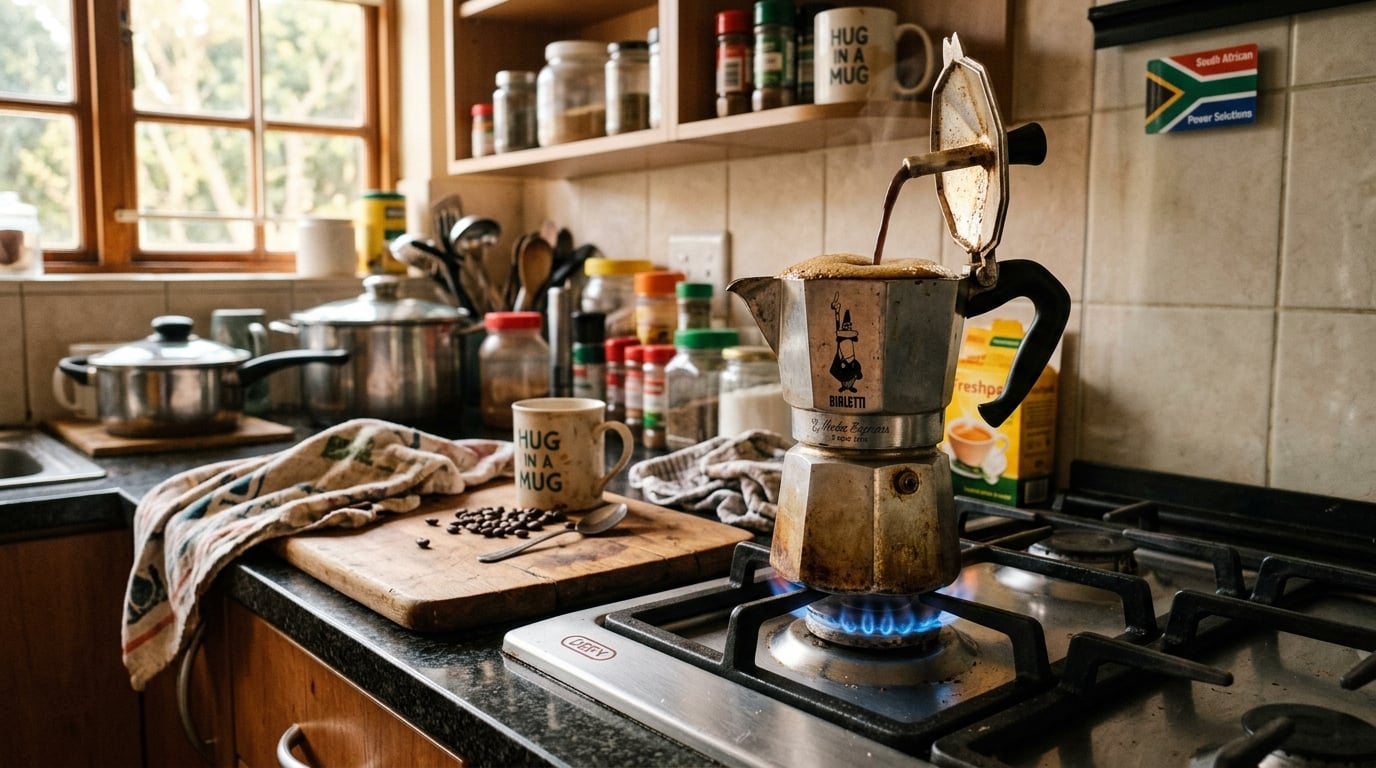
A friend — bless her — lent me her grandmother's Moka Pot. This little aluminium octagonal thing that looked like it belonged in an Italian film from the 1960s. "Just put it on the gas," she said. "It practically makes itself."
She was right.
The first cup from that Moka Pot was a revelation. Strong, rich, slightly smoky from the direct flame. It wasn't espresso — not technically — but it was so much closer than anything I'd expected. I could froth milk in a small pot on the gas hob, and suddenly I was making flat whites at 6 AM by candlelight like some kind of survivalist barista.
I used Terbodore's This Is Coffee blend from Franschhoek, ground the night before on my electric grinder (lesson learned: always grind before the outage). Medium-dark, chocolatey, perfect for the Moka Pot's intense extraction.
For two weeks, I was a Moka Pot convert. Then Eskom upped the ante.
Stage 6: The AeroPress Revelation
Stage 6 changed everything. With four-hour outage blocks and sometimes two per day, I needed something faster, cleaner, and more versatile than the Moka Pot. The gas wasn't infinite either — I'd burned through half a cylinder already.
Someone on Twitter (back when it was still Twitter) recommended the AeroPress. R600 from a local coffee shop. Plastic. Looked like a toy. I was sceptical.
That scepticism lasted exactly one cup.
The first AeroPress brew I made — with pre-boiled water from a thermos, beans ground the night before, by the light of my phone's torch — was the best coffee I'd had in months. Clean. Bright. No bitterness, no sediment, just pure coffee flavour. I could taste the origin of the beans (an Ethiopian from Rosetta Roastery) in a way my espresso machine had never revealed.
I sat at my kitchen table in the dark, power out, candles lit, and thought: "Wait. Is this better than my machine?"
It was.
What I Learned About Coffee (Thanks to Eskom)
Here's the thing about being forced to brew manually: you pay attention. When you can't just push a button and walk away, you start noticing things.
Grind matters more than anything
With my espresso machine, I'd set the grind once and forget about it. With manual brewing, I quickly learned that grind size is everything. Too fine in a French Press and you get mud. Too coarse in an AeroPress and you get tea water. I bought a Timemore C2 hand grinder — R1,200, best money I ever spent — and suddenly I understood why coffee people are obsessed with grind consistency.
Water temperature is not optional
My machine handled water temperature automatically. Manually, I had to think about it. Boiling water burns coffee. Water that's sat too long in a thermos doesn't extract enough flavour. The sweet spot is 90–96°C, and the easiest trick is: boil your kettle, wait 30 seconds, then pour.
In Joburg, where I am, altitude helps — water boils at about 95°C up here, which is basically perfect for coffee. One of the few advantages of living at 1,700 metres.
Fresh beans are non-negotiable
When you're brewing manually, the quality of your beans is the single biggest factor. Pre-ground supermarket coffee tasted acceptable in my espresso machine. In an AeroPress, it tasted like cardboard.
I started buying from local roasters — Bean There in Joburg, Father Coffee in Braamfontein — and the difference was night and day. Beans roasted within the last two weeks, ground fresh (or the night before with my hand grinder), stored in an airtight container. That's the formula.
The ritual is the point
This surprised me most. I thought I loved coffee for the caffeine. Turns out, I love coffee for the ritual. Heating water on the gas stove. Listening to the kettle. Grinding beans by hand — that satisfying crunch. The bloom when hot water hits fresh grounds. The gentle press of the AeroPress plunger.
It's meditative. It's the opposite of the machine's button-push-and-go convenience. And I wouldn't trade it back.
My Stage 6 Setup (the Final Form)
By the end of the worst load shedding period, I'd settled on a setup that worked every single time:
Morning (just me):
- AeroPress + Timemore C2 hand grinder
- 15g coffee, medium-fine grind
- 250ml water from thermos (pre-boiled the night before)
- 2-minute brew, inverted method
- Beans: whatever single-origin I had from Rosetta or Origin
Weekend (with friends):
- French Press, 8-cup
- 60g coffee, coarse grind
- 1L water, heated on gas hob
- 4-minute steep
- Beans: a crowd-pleasing blend from Truth Coffee
Emergency backup:
- Cold brew prepped in a Mason jar the night before
- 100g coarse-ground coffee + 1L cold water
- Steep 16 hours, strain through a cloth
- Keeps for 3 days, tastes incredible with ice and a splash of milk
Total cost of this entire setup? About R2,500. Less than the price of three months of daily café lattes.
The Unexpected Outcome
Load shedding ended — or rather, it was suspended — and my espresso machine is still on my counter. I use it maybe once a week now, usually on weekends when I feel like playing barista. But most mornings, I reach for the AeroPress.
Not because the power is out. Because the coffee is better.
I know how that sounds. I spent thousands on a machine, and a R600 plastic tube does it better? But it's true. The AeroPress gives me cleaner flavour, more control, easier cleanup, and a quiet morning ritual that I genuinely look forward to.
Eskom took a lot from us during those dark years — literally and figuratively. But it accidentally gave me something I didn't expect: a better relationship with coffee.
Your Stage 6 Survival Kit
If you want to be ready for whatever Eskom throws at us next, here's what I'd buy today:
- AeroPress (R500–R700) — Your daily driver
- Timemore C2 hand grinder (R1,200) — The best budget hand grinder
- 1.5L thermos (R250) — Pre-boil water the night before
- French Press (R300) — For when you have company
- Beans from a local SA roaster — Check our Suppliers page for roasters in your city
Total: under R3,000. Coffee insurance for life.
And if load shedding never comes back? You've just upgraded your coffee game permanently. There's no downside.
For the full rundown on every power-free brewing method, read the complete load shedding coffee guide. Or if you're trying to decide between just two brewers, read AeroPress vs French Press: Which Wins?
One Last Thing
To my espresso machine: I still love you. But we're in an open relationship now.
☕
Bibi Burness is the founder of Coffee Journal, a South African specialty coffee community. He's a self-confessed coffee amateur, learning daily, bean by bean.
Keep Reading

About the author
Bibi Burness, founder of Coffee Journal, has profiled 50+ SA specialty roasters and tested 10+ bottled water brands against the SCA standard. He completed the Bean There and Bluebird one-day home-barista courses in 2026 and maintains the site's transparency trust-score system.
Read more on the About page →