The Complete South African Guide to Coffee During Load Shedding
Lost power but still need your fix? The complete South African guide to brewing exceptional coffee during load shedding — methods, gear, and city-by-city tips from Coffee Journal.
Key Takeaways
- Let me be honest with you — when load shedding first hit, I panicked.
- As of June 2026, South Africa has been load-shedding-free for about twelve months.
- Here's the thing — you don't need electricity to make world-class coffee.
- If you know load shedding is coming (check your schedule on EskomSePush), here's what to do before the lights go out:
How to Make Great Coffee When the Lights Go Out
Let me be honest with you — when load shedding first hit, I panicked. Not about the fridge. Not about the Wi-Fi. About my espresso machine. My beautiful, electricity-dependent, utterly useless espresso machine sitting there like a very expensive paperweight while I stared at it in the dark.
That was Stage 4, sometime in 2023. By Stage 6, I'd figured it out. And now, even though Eskom has kept the lights on for over a year, I still brew manually most mornings. Not because I have to — because the coffee is genuinely better.
This guide is everything I've learned. Whether load shedding comes back tomorrow or you're just curious about off-grid brewing, this is for you.
Why This Guide Exists (Even With Load Shedding Suspended)
As of June 2026, South Africa has been load-shedding-free for about twelve months. But if you've lived here long enough, you know the pattern. It goes away. It comes back. And when it comes back, it comes back fast.
The beauty of manual brewing is that it's not just a backup plan. It's genuinely brilliant coffee. The AeroPress, French Press, V60, Moka Pot — these aren't compromises. They're how most of the world's best baristas actually prefer to brew.
So think of this guide as two things:
- Your coffee insurance policy for the next outage
- An invitation to discover brewing methods that might actually be better than your machine
The 6 Power-Free Brewing Methods
Here's the thing — you don't need electricity to make world-class coffee. You need heat (gas, fire, or a thermos of pre-boiled water) and a manual brewer. That's it.
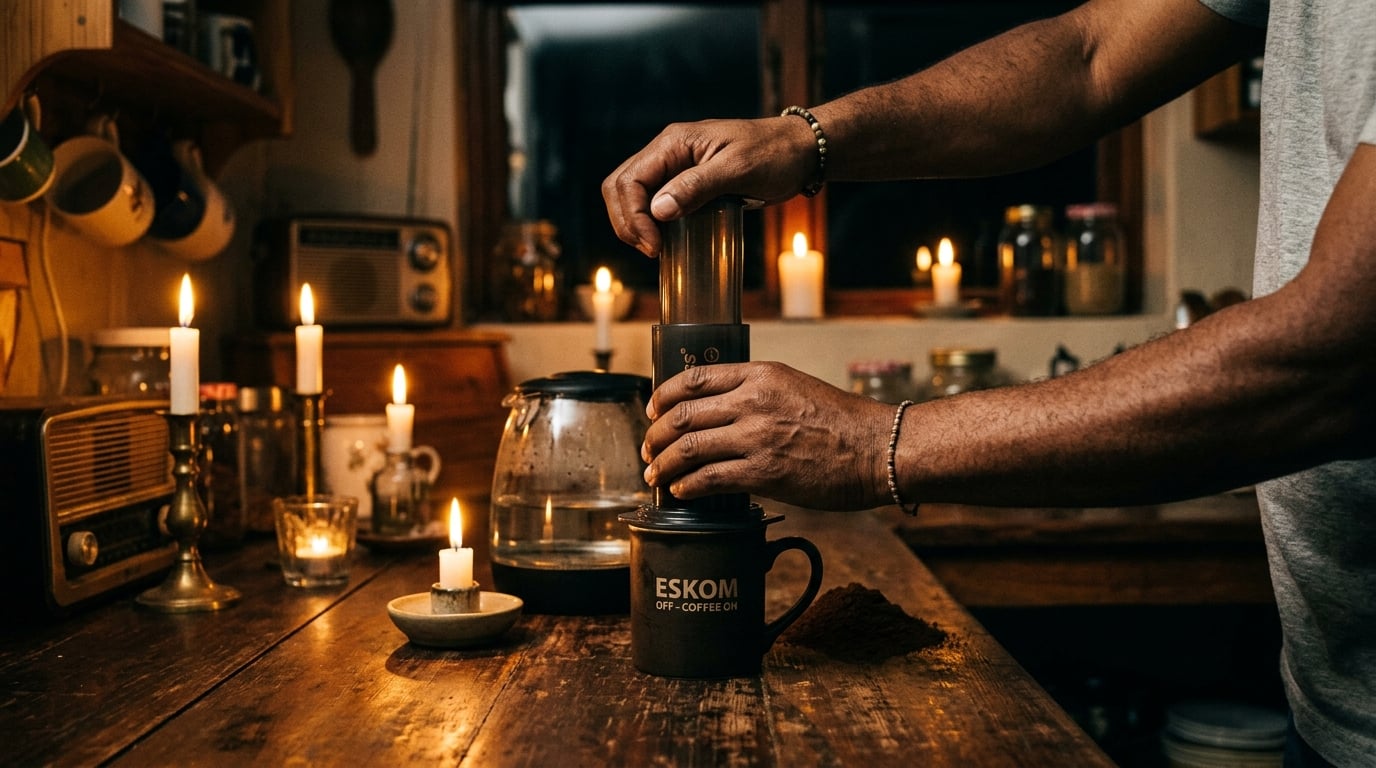
AeroPress — The Load Shedding Champion
Brew time: 2–4 minutes | Serves: 1 cup | Skill: Beginner
If I could only own one coffee maker, it would be the AeroPress. It's plastic, it's indestructible, it travels anywhere, and it makes a clean, bright cup that rivals espresso. During Stage 6, this was my daily driver.
What you need: AeroPress + gas kettle or thermos of hot water Best beans: Single-origin light to medium roasts — check out Origin Coffee Roasting or Rosetta Roastery in Cape Town for incredible options.
French Press — The Crowd Pleaser
Brew time: 4 minutes steep | Serves: 2–4 cups | Skill: Beginner
When the power goes out and the whole family needs coffee, the French Press is your friend. It's forgiving, it makes multiple cups, and the full-bodied flavour is rich and satisfying. The only downside? It can be a bit gritty if your grind is too fine.
What you need: French Press + gas kettle Best beans: Medium to dark roasts work beautifully — try Bean There Coffee Company in Joburg or Truth Coffee in Cape Town.
For a detailed head-to-head comparison, read our AeroPress vs French Press guide.
V60 Pour-Over — For the Flavour Chasers
Brew time: 3–4 minutes | Serves: 1–2 cups | Skill: Intermediate
The V60 is where manual brewing gets exciting. You control every variable — water temperature, pour speed, bloom time. The result is a clean, complex cup that highlights the origin character of your beans. It does require a gooseneck kettle for best results, which means a gas hob.
What you need: V60 dripper + filters + gooseneck kettle + gas hob Best beans: Light roasts, single-origin African coffees. Quaffee in Stellenbosch does exceptional Ethiopian and Kenyan lots.
Moka Pot — Stovetop Espresso
Brew time: 5 minutes | Serves: 1–3 cups | Skill: Beginner
The Moka Pot is a South African braai-day classic. It sits directly on your gas hob and produces a strong, concentrated coffee that's somewhere between filter and espresso. It's not true espresso (no 9-bar pressure), but it's close enough that you can make a decent flat white with it.
What you need: Moka Pot + gas hob Best beans: Medium-dark blends. Terbodore in Franschhoek makes a brilliant blend that's born for the Moka Pot.
Read about how I survived Stage 6 using my Moka Pot and gas stove.
Cold Brew — The Night-Before Hero
Brew time: 12–18 hours | Serves: 3–6 cups | Skill: Effortless
Here's the secret weapon: cold brew needs zero power. No heat, no gas, nothing. You steep coarse-ground coffee in cold water overnight, strain it in the morning, and you've got smooth, low-acid concentrate that lasts three days in the fridge (even without power, it's fine for a day).
What you need: A jar + a filter/cloth + patience Best beans: Anything goes, but darker roasts give a chocolatey, sweet result.
Stovetop Percolator — The Group Brewer
Brew time: 7 minutes | Serves: 4–8 cups | Skill: Beginner
When you're hosting a braai and the power is out, the percolator is king. It's old-school, it makes a strong pot, and it works on any heat source — gas, fire, camping stove. The coffee won't win any barista competitions, but it's hot, it's strong, and there's enough for everyone.
What you need: Percolator + any heat source Best beans: Pre-ground is fine here. This is survival coffee.
Your Pre-Outage Checklist
If you know load shedding is coming (check your schedule on EskomSePush), here's what to do before the lights go out:
- Grind your beans now — Your electric grinder won't work during the outage. Grind enough for the whole session. If you don't have a hand grinder, this is non-negotiable.
- Boil extra water — Fill your thermos. Fill your flask. Fill a pot. Hot water is everything.
- Check your gas — Make sure your gas bottle isn't empty. Seems obvious. You'd be surprised.
- Prep your brewer — Set up your AeroPress, French Press, or V60 with a filter ready to go. When you're fumbling in the dark, you'll thank yourself.
- Ice for cold brew — If you're planning cold brew, make sure you've got ice or cold water sorted.
- Milk plan — If you're a milk drinker, heat extra milk before the outage and store it in a thermos. Or switch to black — you might discover you actually prefer it.
- Candles or headlamp — You need to see what you're doing. A headlamp is surprisingly useful for coffee prep in the dark.
City-by-City: How Altitude and Water Affect Your Brew
South Africa's geography means your coffee will taste different in Cape Town versus Johannesburg. Here's why:
High altitude cities (Joburg, Pretoria, Centurion, Clarens, Bloemfontein): Water boils at a lower temperature at altitude — roughly 95°C instead of 100°C in Joburg. This actually works in your favour for most manual methods, but you may need to extend your brew time by 15–30 seconds.
Coastal cities (Cape Town, Durban, Port Elizabeth, George): Sea-level brewing is straightforward. Water boils at 100°C, which is actually too hot for most coffee. Let it cool for 30 seconds after boiling.
Hard water areas (Joburg, Pretoria, Klerksdorp, Vaal Triangle): Hard water can make your coffee taste flat and chalky. If your tap water tastes off, use filtered water or bottled spring water for brewing.
Soft water areas (Cape Town, Stellenbosch, KZN Midlands): Soft water produces cleaner, brighter coffee. Lucky you.
The Gear You Actually Need
Don't overthink this. Here's the minimum kit:
- One manual brewer — AeroPress (R500–R700) or French Press (R200–R400)
- Gas kettle or stovetop kettle — any kettle that works on gas (R150–R300)
- Hand grinder — Timemore C2 or 1Zpresso Q2 are excellent budget options (R800–R1,500)
- Thermos — For storing pre-boiled water (R150–R400)
- Kitchen scale — Optional but helpful (R200)
Total investment: R1,000–R3,000. That's less than two months of Vida e Caffè.
Frequently Asked Questions
Can I run my espresso machine on a UPS or inverter? Technically yes, but most home espresso machines draw 1,200–1,800 watts. You'd need a serious (and expensive) inverter. For the same money, you could buy every manual brewer on this list and have change for a year's worth of beans.
Is pre-ground coffee okay during load shedding? It's better than no coffee. But freshly ground is noticeably better, even with a cheap hand grinder. Pre-ground loses flavour within hours of grinding. If you must use pre-ground, store it in an airtight container and use it within two weeks of opening.
How do I heat water without electricity or gas? A camping stove with a gas canister works perfectly. In a pinch, you can even use a braai — just put a kettle on the coals. Some people use gel fuel or methylated spirits stoves. Whatever works.
What's the best method for someone who's never brewed manually? French Press. It's the most forgiving — you just add water, wait four minutes, and press. You can't really mess it up.
Does altitude really affect my coffee? Yes. In Johannesburg (1,753m), water boils at about 95°C. In Cape Town (sea level), it boils at 100°C. Most coffee extracts best between 90–96°C, so Joburg's altitude is actually an advantage.
Can I make espresso without electricity? Not real espresso (that requires 9 bars of pressure). But a Moka Pot makes strong, concentrated coffee that's close enough for a flat white or cappuccino.
How long does cold brew last without a fridge? About 24 hours at room temperature, longer if it's winter. In a cooler box with ice, 2–3 days easily.
Where can I find good beans in my city? Check our SA Roasters directory — we track over 50 roasters across the country with trust scores and reviews.
The Silver Lining
Here's what I didn't expect when load shedding forced me to brew manually: I fell in love with coffee all over again. The ritual of heating water on the gas, grinding beans by hand, watching the bloom in a V60 — it's meditative. It's intentional. And the coffee? Honestly, it's better than what my machine was making.
So whether Eskom brings the darkness back tomorrow or keeps the lights on forever, you've got options. Good options. Delicious options.
Now go grind some beans. ☕
Bibi Burness is the founder of Coffee Journal, a South African specialty coffee community. He tracks his espresso journey, explores local roasters, and shares everything he learns — bean by bean.
Keep Reading

About the author
Bibi Burness, founder of Coffee Journal, has profiled 50+ SA specialty roasters and tested 10+ bottled water brands against the SCA standard. He completed the Bean There and Bluebird one-day home-barista courses in 2026 and maintains the site's transparency trust-score system.
Read more on the About page →