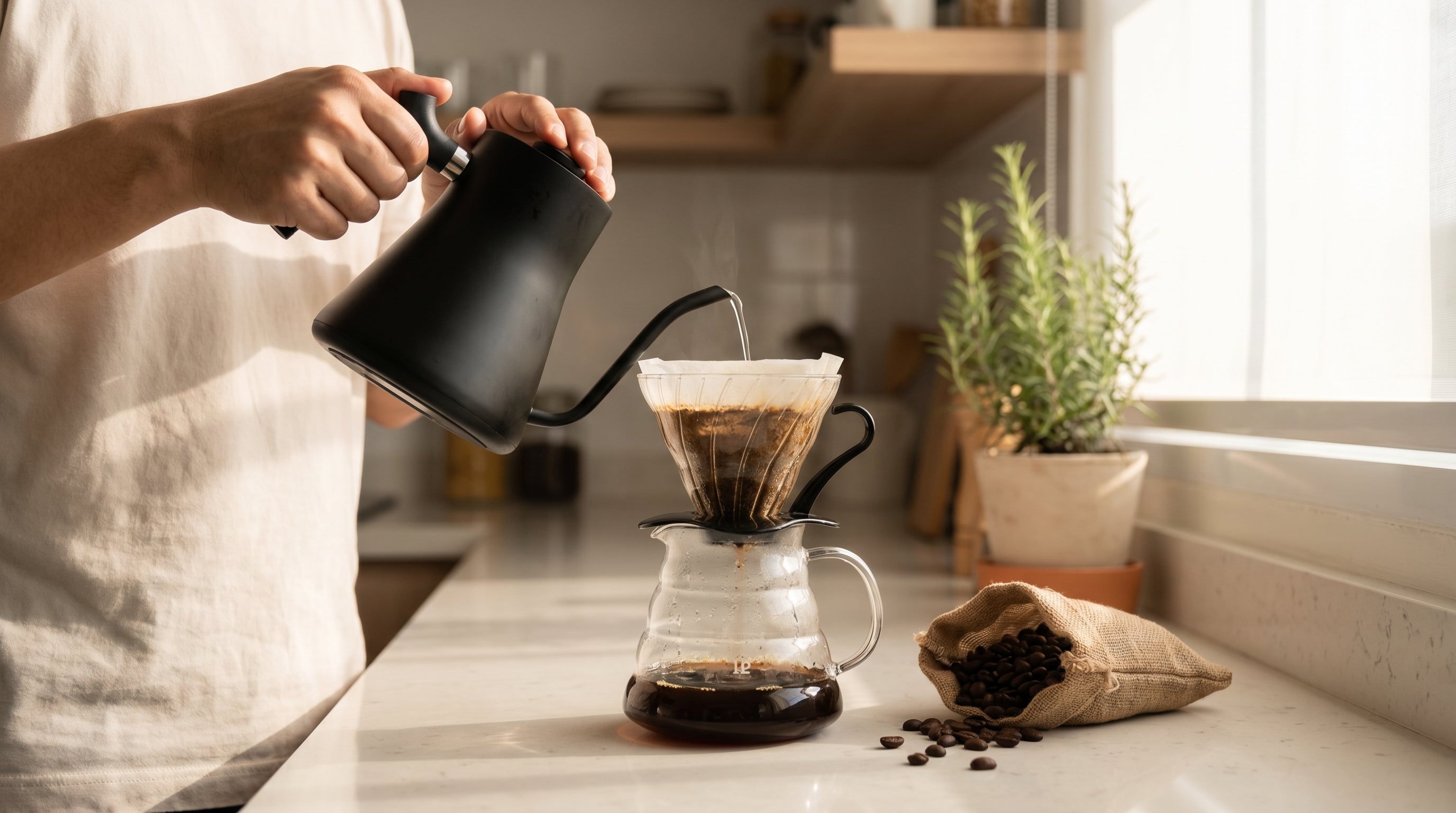
SA Water for Coffee — Why Tap Water Ruins Your Brew & How to Fix It
Why the same beans taste different in Cape Town and Joburg, which bottled water scores best for espresso, and how to fix hard SA tap water for coffee.
Key Takeaways
- I'm going to say something that sounds dramatic but is genuinely true: water is 98% of your filter coffee and 90% of your espresso.
- The SCA published a water standard based on decades of sensory research.
- Here's the uncomfortable truth: only two water authorities in South Africa publish actual mineral data — Rand Water (Gauteng) and the City of Cape Town.
- I tested 10+ SA bottled brands against the SCA standard and scored them for espresso and filter separately.
The Most Important Ingredient You're Ignoring
I'm going to say something that sounds dramatic but is genuinely true: water is 98% of your filter coffee and 90% of your espresso. The beans get all the glory, but the water is doing the heavy lifting.
I discovered this the hard way. I bought the same bag of beans from Origin Coffee Roasting in Cape Town and brewed it at home in Meyerton, Gauteng. Same dose. Same grind. Same recipe. The Cape Town cup was bright and fruity. The Meyerton cup was rounder, fuller, with less acidity. Same beans. Completely different coffee.
The difference? Water.
Cape Town's tap water is incredibly soft — some zones have a TDS (total dissolved solids) as low as 51 mg/L. Gauteng's Rand Water sits around 150–180 mg/L. That's not a small gap. It's the gap between under-extracted and well-extracted coffee.
So I went down the rabbit hole. I read the SCA (Specialty Coffee Association) water standard. I pulled every municipal water report I could find. I tested bottled water brands. And I built a tool that puts it all in one place.
→ Check your water quality for coffee
What the SCA Says Good Coffee Water Looks Like
The SCA published a water standard based on decades of sensory research. The numbers that matter most:
- TDS: 75–250 mg/L (ideal: 150)
- Total hardness: 50–175 mg/L CaCO₃ (ideal: 68)
- Alkalinity: 40–70 mg/L CaCO₃ (ideal: 40)
- pH: 6.0–8.0 (ideal: 7.0)
Alkalinity is the big one. It's the buffer that controls how much acidity you taste in the cup. Too high and your coffee tastes flat and dull. Too low and it's sharp, sour, all over the place. Most SA municipalities don't even publish it.
The SA Tap Water Picture — City by City
Here's the uncomfortable truth: only two water authorities in South Africa publish actual mineral data — Rand Water (Gauteng) and the City of Cape Town. Everyone else just says "SANS 241 compliant" (which means it's safe to drink, but tells you nothing about how it brews).
Gauteng — You're Lucky
If you live in Joburg, Pretoria, Centurion, Meyerton or the East Rand, your tap water is already surprisingly close to the SCA ideal. Rand Water's Vaal system delivers hardness around 73–81 mg/L, TDS 150–180, and a neutral pH. That's good coffee water.
The missing piece? Alkalinity. Rand Water doesn't publish it. I've used a research-backed estimate (alkalinity ≈ hardness for bicarbonate-dominated SA water), but it's a fallback, not a measurement. If you want to know for sure, a R60 aquarium GH/KH test kit from Builders or Takealot will tell you in two minutes.
My honest advice for Gauteng: a basic carbon filter jug (Brita, BWT Penguin — around R200–R400) to strip the chlorine taste, and you're golden. No need to buy bottled.
Cape Town — Too Soft for Coffee
Cape Town is the opposite problem. The water is beautifully clean and soft — hardness as low as 20 mg/L, TDS around 50–80. That's below the SCA minimum. Your coffee will tend towards thin, sour, and under-extracted no matter how dialled-in your grinder is.
The one exception: Simon's Town (Brooklands supply zone) sits at hardness 88 and TDS 287 — the hard outlier in a soft city.
If you're in Cape Town, filtering your tap won't help (you can't filter minerals into water). You need to remineralise, or switch to a bottled water that's closer to spec.
The Rest of SA — A Data Desert
Durban, KZN Midlands, Stellenbosch, Franschhoek, Bloemfontein, Gqeberha, Polokwane, Kimberley — none of them publish mineral concentrations. Just pass/fail compliance. It's frustrating.
For these cities, a TDS pen (R150–R350 from Aqua-Pura or Dis-Chem) gives you a starting read. For the full picture, grab that GH/KH test kit.
→ See the full city-by-city breakdown
Bottled Water — What Actually Works?
I tested 10+ SA bottled brands against the SCA standard and scored them for espresso and filter separately. Here's the short version:
Valpré — The Best Off-the-Shelf Option
Score: 4.5/5 (espresso & filter)
Hardness ~66 (almost exactly the SCA ideal of 68), alkalinity 53 (in range), pH 7.0 (neutral). The catch: Coca-Cola doesn't publish TDS for the SA product — independent tests put it around 40–90, which may dip below the SCA floor. But it's the closest mainstream SA bottled water to ideal.
RE Beverages — The Best-Documented Option
Score: 3.5/5 (filter) · 4/5 (espresso)
A niche Paarl spring water with published analysis: hardness ~71, TDS 190, pH 7.1. Alkalinity 31 is a touch below the SCA minimum, but very usable. Hard to find in mainstream shops.
aQuellé — SA's Best-Seller, But…
Score: 2/5
Lovely to drink, but for coffee it's almost too pure. TDS 60, hardness ~18, alkalinity <15 — all well below SCA minimums. Your coffee will taste thin and sour. Unless you remineralise it (see below).
The Thirsti Trap
Watch the label. Thirsti has two completely different water sources — Tulbagh (hardness ~139, over-mineralised) and Normandien (hardness ~16, sodium-bicarbonate heavy, pH 8.9). Same brand, totally different coffee outcome. And Woolworths own-label still water? Same Normandien source.
→ Score every brand in the interactive tool
The Real Winner: Third Wave Water Sachets
Here's the honest truth that none of the bottled brands want to hear: the best coffee water in South Africa comes from a sachet.
Third Wave Water makes mineral sachets designed specifically for coffee. You add one sachet to a gallon (3.78 L) of distilled or reverse-osmosis water, and you get water that hits the SCA target on purpose, every single time.
They make two versions:
- Espresso Profile — TDS ~150, alkalinity ~80. Scale-safe, repeatable, designed for machines.
- Classic Light — TDS ~150, alkalinity ~40. Bright, fruit-forward, perfect for pour-over and filter.
Where to Buy in SA
The best local stockist I've found is Cape Coffee Beans — they carry both profiles at around R600 for a 20-pack. That's 20 gallons = ~75 litres. At 250 ml per pour-over, that's 300 cups of perfectly mineralised water for R600 — about R2 per cup for the water alone.
You'll also need distilled water as your base. Dis-Chem sells 5L bottles for around R50–R120, or you can do refills at some supermarkets for R5–R15 per litre.
Is It Worth It?
If you're spending R250+ on a bag of specialty beans — yes. Absolutely. The difference between aQuellé (score: 2/5) and Third Wave Water (score: ~5/5) is like the difference between a R50 supermarket blend and a single-origin from Tribe Coffee. You can literally taste the minerals.
If you're brewing Ricoffy in a plunger — no. Save your money. The water won't matter nearly as much.
The DIY Route (For the Curious)
If you want to go deeper, you can make your own mineralised water. The basic recipe:
- Start with distilled or RO water (TDS ≈ 0)
- Add Epsom salts (magnesium sulphate, food-grade — Faithful to Nature ~R80/kg) for hardness
- Add bicarbonate of soda (Checkers, ~R20) for alkalinity
The exact ratios depend on your target. There's a whole community around this — search "DIY coffee water recipe" and you'll find spreadsheets and calculators. But for most home baristas, Third Wave Water is easier and more consistent.
What I'd Actually Recommend
Depending on where you live:
Gauteng (Joburg, Pretoria, Centurion, Meyerton, East Rand): Your tap is already solid. Get a carbon filter jug to strip the chlorine. Job done.
Cape Town: Your tap is too soft. Either buy Valpré (closest to ideal) or go the Third Wave Water route on distilled.
Durban, Stellenbosch, Bloemfontein, other cities: Get a TDS pen first. If your reading is 75–250, a carbon filter is probably enough. If it's below 75, treat it like Cape Town.
Anywhere, if you want the best: Third Wave Water sachets + distilled base. It's repeatable, it's SCA-certified, and it genuinely tastes different.
→ Check your water and get personalised advice
The Tool I Built
I put everything I learned into an interactive tool on Coffee Journal. Pick your city or bottled brand and get:
- Your mineral profile vs the SCA standard
- A colour-coded verdict (in range / below / above)
- Plain-English explanation of what it means for your cup
- A hardness × alkalinity scatter plot showing where you sit
- Personalised recommendations
Every number is sourced and dated. Where data isn't published, I say "not published" rather than guessing. Where I've estimated, I've flagged it.
→ Try the SA Water Quality Guide now
While You're Here
If you're this deep into your coffee game, you might also enjoy:
- The Complete Grind Size Guide — every grind size, every brew method, 20+ grinder settings with measured micron values
- SA Roaster & Supplier Directory — find your next bag from a local roaster with community trust scores
- Verify My Roaster — rate roasters on transparency, traceability and quality
- The Load Shedding Coffee Guide — still relevant, because Eskom
- Log your espresso shots — track your grind, dose, and yield to dial in faster
Or just browse the blog — I write about whatever I'm learning that week.
I'm not a water scientist. I'm a home barista who got obsessed with why the same beans taste different in different cities. Every number in this article (and in the water quality tool) is sourced and dated. If I got something wrong, please tell me: [email protected].
— Bibi Burness, Coffee Amateur
Keep Reading

About the author
Bibi Burness, founder of Coffee Journal, has profiled 50+ SA specialty roasters and tested 10+ bottled water brands against the SCA standard. He completed the Bean There and Bluebird one-day home-barista courses in 2026 and maintains the site's transparency trust-score system.
Read more on the About page →