A Brief History of Coffee Makers: From the Turkish Cezve to the AeroPress
From the 16th-century Turkish cezve to the 2005 AeroPress — origin stories behind 8 iconic brewers, their inventors and where they began.
For as long as people have loved coffee, they've been trying to brew it better. Every device on the shelf — from the humblest stovetop pot to the most theatrical glass contraption — was once someone's answer to a simple question: how do I get a better cup out of these beans? Here are eight of the most iconic brewers, in the order they arrived, and the stories behind them.
1500s — The Turkish Cezve (Ottoman Empire)
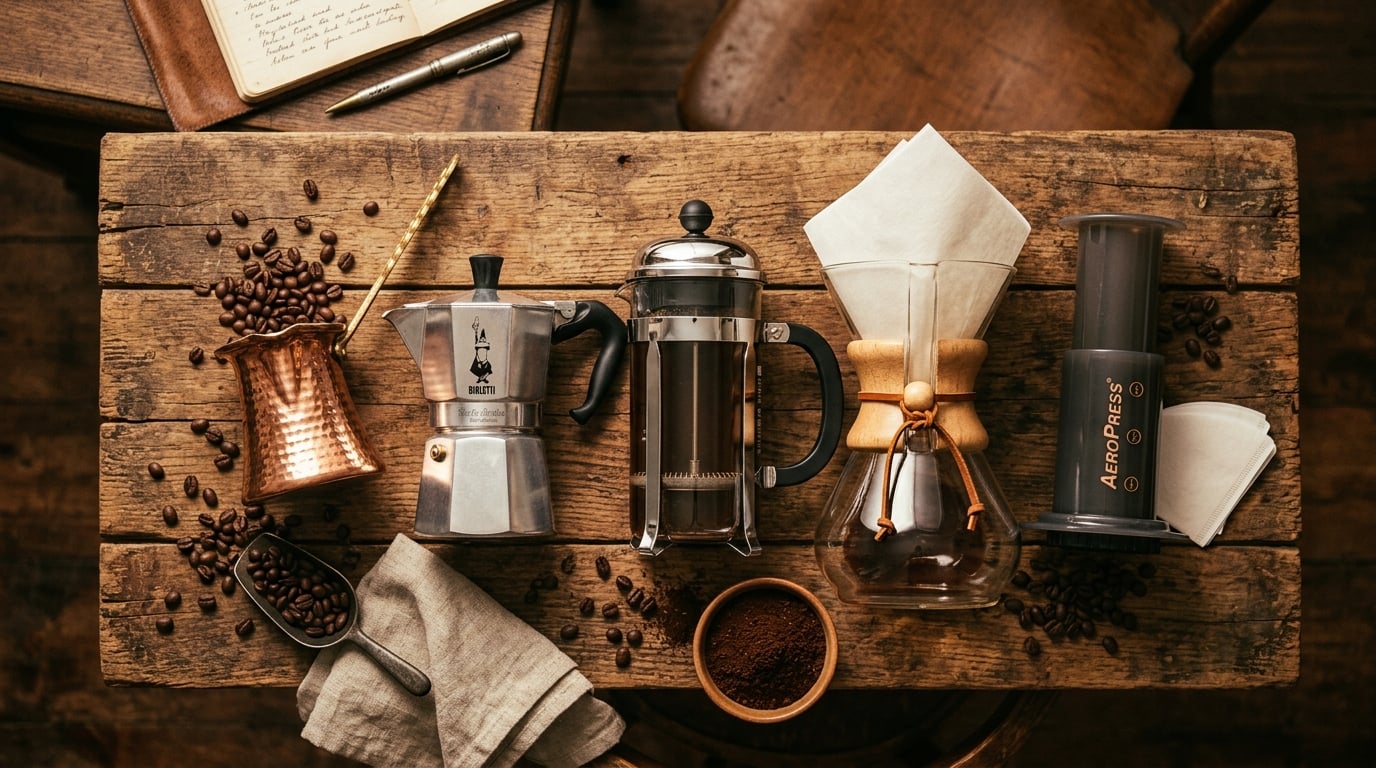
The story of brewed coffee really begins in the 16th-century Ottoman Empire, where coffee was simmered in a small, long-handled copper or brass pot known as a cezve (or ibrik). Very finely ground coffee — almost a powder — is brought slowly to the edge of a boil with water, often together with sugar and spices like cardamom, then poured, grounds and all, into small cups. The grounds settle at the bottom, and the rest is sipped thick and unfiltered.
It was around this method that the world's first coffeehouses sprang up in Constantinople, becoming centres of conversation and culture. And it endures: the cezve remains the traditional way to make coffee across the Middle East, the Balkans, and North Africa to this day.
1830 — The Siphon (Germany)
Few brewers are as mesmerising to watch as the siphon, or vacuum pot. The earliest known patent was filed by a figure recorded only as Loeff of Berlin, around 1830 — though his fragile glass design never caught on commercially. It took a Frenchwoman, Madame Vassieux of Lyon, to popularise the first commercially successful version in 1840.
The siphon uses heat to drive water up from a lower glass globe into an upper chamber, where it brews, then lets a vacuum draw the finished coffee back down through a filter. It's a small piece of theatre that produces a famously clean, bright cup. The method faded from fashion in the West, but it's still treated as a refined art form in Japan and Taiwan.
1884 — The Espresso Machine (Italy)
The machine that would come to define café culture began with a patent granted to Angelo Moriondo of Turin in 1884, for a steam-driven device that brewed coffee in bulk. Others refined the idea into something practical for serving one cup at a time — most notably Luigi Bezzera and Desiderio Pavoni in the early 1900s.
From there, the espresso machine — forcing hot water through finely ground coffee under pressure to produce a small, intense shot — became the beating heart of the modern coffee bar, and the foundation for the cappuccinos and flat whites we order without a second thought today.
1908 — The Pour-Over and Paper Filter (Germany)
Sometimes the best inventions are born of sheer frustration. In 1908, a German housewife named Melitta Bentz, tired of bitter, gritty coffee, punched holes in the bottom of a brass pot and lined it with a sheet of blotting paper torn from her son's school exercise book. Hot water passed through the grounds, the paper caught every speck, and out came a clean, sediment-free cup.
The paper filter was born, Bentz founded the company that still carries her name, and the simple, elegant pour-over remains one of the most popular ways to brew filter coffee around the world.
1929 — The French Press (Italy)
Here's a small irony: the French press wasn't French. While an early plunger-style design had been patented in France back in 1852, the first version closely resembling the one we use today was patented in 1929 by two Italians, Attilio Calimani and Giulio Moneta. A later refinement — the Chambord — was popularised by the Swiss-Italian Faliero Bondanini in 1958, and it was that French-made model that finally cemented the "French" name.
The method couldn't be simpler: coffee steeps directly in hot water, then a mesh plunger pushes the grounds to the bottom. Because nothing strips out the coffee's natural oils, the press delivers a full-bodied, richly textured cup.
1933 — The Moka Pot (Italy)
In 1933, the Italian engineer Alfonso Bialetti brought espresso-style coffee into the home with the Moka Express — the unmistakable octagonal aluminium pot that has sat on stovetops in Italian kitchens ever since. It works by pushing water, heated to steam in the base, up through a bed of coffee and into the top chamber.
Bialetti's little moustached man, l'omino coi baffi, still graces the pots today, and few household objects are as bound up with everyday Italian life.
1941 — The Chemex (United States)
Part coffee maker, part sculpture, the Chemex was invented in 1941 by Peter Schlumbohm, a German chemist who had settled in the United States. He designed it as a chemist would: an elegant single piece of borosilicate glass shaped like an hourglass, finished with a wooden collar and a thick, specially made filter that yields an exceptionally clean, bright cup.
It was as much a design statement as a brewer — so much so that examples sit in the permanent collection of New York's Museum of Modern Art.
2005 — The AeroPress (United States)
The most modern icon on the list comes from an unlikely inventor: Alan Adler, a Stanford engineer best known for creating the Aerobie flying ring. In 2005, he set out to make a single, quick, less bitter cup — and produced the AeroPress, a simple plastic cylinder that combines immersion brewing with gentle air pressure from a plunger.
Cheap, near-indestructible, fast, and remarkably forgiving, it earned a devoted following almost overnight. It now has its own world championship, where competitors travel from across the globe to coax the best possible cup from this humble tube.
Nearly five centuries separate a copper pot simmering over Ottoman coals from a plastic plunger dreamed up by a flying-disc engineer — and yet they're all chasing the same thing. The materials change, the mechanisms get cleverer, but every coffee maker ever made is really just one more attempt to answer the oldest question in coffee: how do I make this taste better?
Whichever one you reach for, it always starts the same way — with good beans.
Read next
- The Journey of a Coffee Bean: From Cherry to Ground — the ten stages that produce those beans.
- Coffee Processing Methods: Natural, Honey, Washed & Anaerobic — how the fruit is removed shapes what you taste.
- Bean There, 2026: The Course That Switched My Coffee Brain On — pulling shots on a La Marzocco with all of this context.

About the author
Bibi Burness, founder of Coffee Journal, has profiled 50+ SA specialty roasters and tested 10+ bottled water brands against the SCA standard. He completed the Bean There and Bluebird one-day home-barista courses in 2026 and maintains the site's transparency trust-score system.
Read more on the About page →