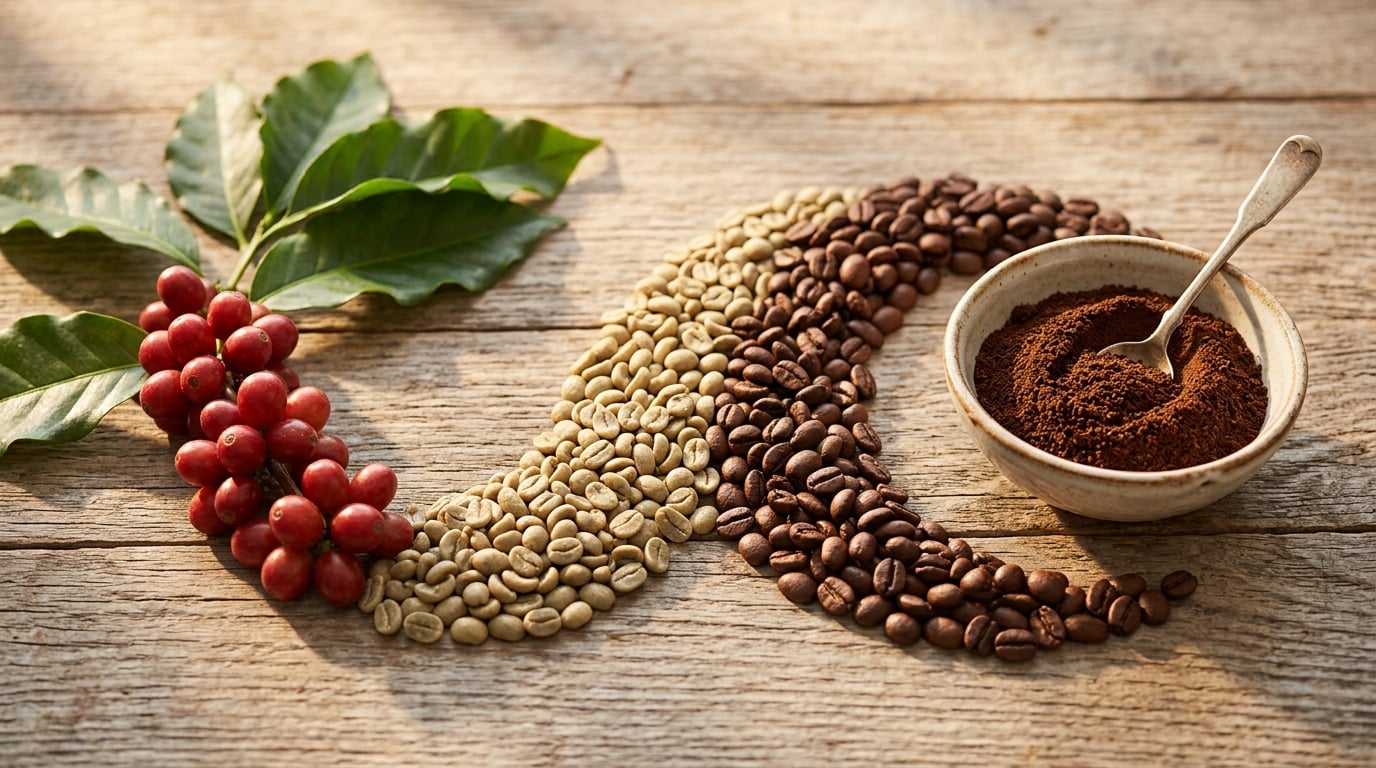
The Journey of a Coffee Bean: From Cherry to Ground
Follow coffee through all 10 stages — from a red cherry on the plant to the fresh ground in your cup. A beginner's guide to how coffee is made.
Before coffee is a drink, it's a fruit. Long before it becomes the dark, fragrant grind that goes into your machine each morning, it's a small red cherry ripening on a shrub somewhere near the equator. The journey from that cherry to the coffee in your cup passes through ten distinct stages, and each one shapes how the final brew tastes. Here's the whole story, from seed to ground.
1. The Coffee Cherry
Coffee grows on a shrub of the genus Coffea, in the warm belt of countries that straddle the equator. The fruit it produces is called a cherry, and when ripe it turns a deep, glossy red — though some varieties ripen yellow or orange. What we casually call a coffee "bean" isn't a bean at all: it's the seed of this fruit. Most cherries hold two of them, sitting flat-side to flat-side inside the sweet pulp.
2. Harvesting
Once the cherries reach peak ripeness, they're picked. On the best farms this is done by hand and selectively — pickers return to the same trees again and again to take only the ripe fruit and leave the rest to mature. It's slow, labour-intensive work, but ripeness is everything. A cherry picked at its sweetest gives a sweeter, more balanced cup, while underripe fruit brings harsh, green flavours that no amount of skilful roasting can fully hide.
3. Processing
A fresh cherry is mostly fruit — skin, sweet pulp, and a sticky layer called mucilage, all wrapped around the seeds. Before the coffee can be dried and shipped, those outer layers have to come off. How a producer does this is one of the biggest decisions in the entire chain, and it has a name: processing. Whether the fruit is washed away, left on, or fermented changes the flavour of the cup dramatically — enough that it deserves an article of its own.
4. Drying
However the fruit is removed, the seeds that remain are far too wet to store. They're spread out to dry — on raised beds, on patios, or in mechanical dryers — and slowly brought down to around 11–12% moisture. Get this wrong and the coffee spoils or ages badly. Get it right and the bean becomes stable enough to travel halfway around the world without losing its character.
5. The Green Bean
Dried and hulled, the seed is now what the industry calls green coffee — pale, dense, and faintly grassy-smelling. This is the form in which almost all coffee is traded and shipped across the globe. It's shelf-stable for months, and, crucially, it hasn't been roasted yet. A green bean tastes nothing like the coffee you know.
6. Roasting
This is where the magic happens. Under carefully controlled heat, the green bean transforms: sugars caramelise, hundreds of aromatic compounds develop, and the bean swells, darkens, and cracks audibly. Roasting is what turns a bland green seed into something that smells of chocolate, fruit, nuts, or caramel. A lighter roast keeps more of the bean's origin character and acidity; a darker roast pushes toward bolder, roastier flavours.
7. Cooling
The moment a roast reaches the right point, it has to be stopped — fast. Roasted beans are rushed out of the heat and cooled with rushing air (or sometimes a fine mist of water) to halt the cooking before it goes too far. Skip this step and the residual heat keeps roasting the beans from the inside, tipping a perfect roast into a burnt one.
8. The Whole Bean
Now we have roasted, whole-bean coffee: aromatic, glossy, and ready to use. This is also where freshness starts ticking. Roasted coffee is at its best in the weeks after roasting and slowly fades as it's exposed to air — which is exactly why buying whole beans and grinding them yourself gives you a fresher cup than pre-ground coffee ever can.
9. Grinding
Just before brewing, the beans are ground to expose far more surface area to water. Grind size is matched to the brewing method: coarse for a French press, medium for a pour-over, fine for espresso. Too coarse and the coffee comes out weak and sour; too fine and it turns bitter and muddy. Dialling in the right grind is one of the simplest ways to improve any cup at home.
10. Ground Coffee
And here we arrive: ground coffee, ready to meet hot water. From a red cherry on a faraway hillside to the grind in your filter, the bean has passed through ten stages and many months of patient work. The next step is yours.
Every cup of coffee is the end of a long journey — one that involves farmers, pickers, processors, roasters, and, finally, you. Understanding the stages isn't just good trivia; it makes you a sharper buyer and a better brewer. And once you know where coffee comes from, the natural next question is how it's processed — because that's where the real flavour differences begin.
Read next
- Coffee Processing Methods: Natural, Honey, Washed & Anaerobic — the deep dive into what happens at Stage 3.
- A Brief History of Coffee Makers: Cezve to AeroPress — what happens after the grind meets water.
- Bean There, 2026: The Course That Switched My Coffee Brain On — my day learning all of this in person at 44 Stanley.

About the author
Bibi Burness, founder of Coffee Journal, has profiled 50+ SA specialty roasters and tested 10+ bottled water brands against the SCA standard. He completed the Bean There and Bluebird one-day home-barista courses in 2026 and maintains the site's transparency trust-score system.
Read more on the About page →