Best Manual Espresso Grinder in South Africa Under R1,500 (2026)
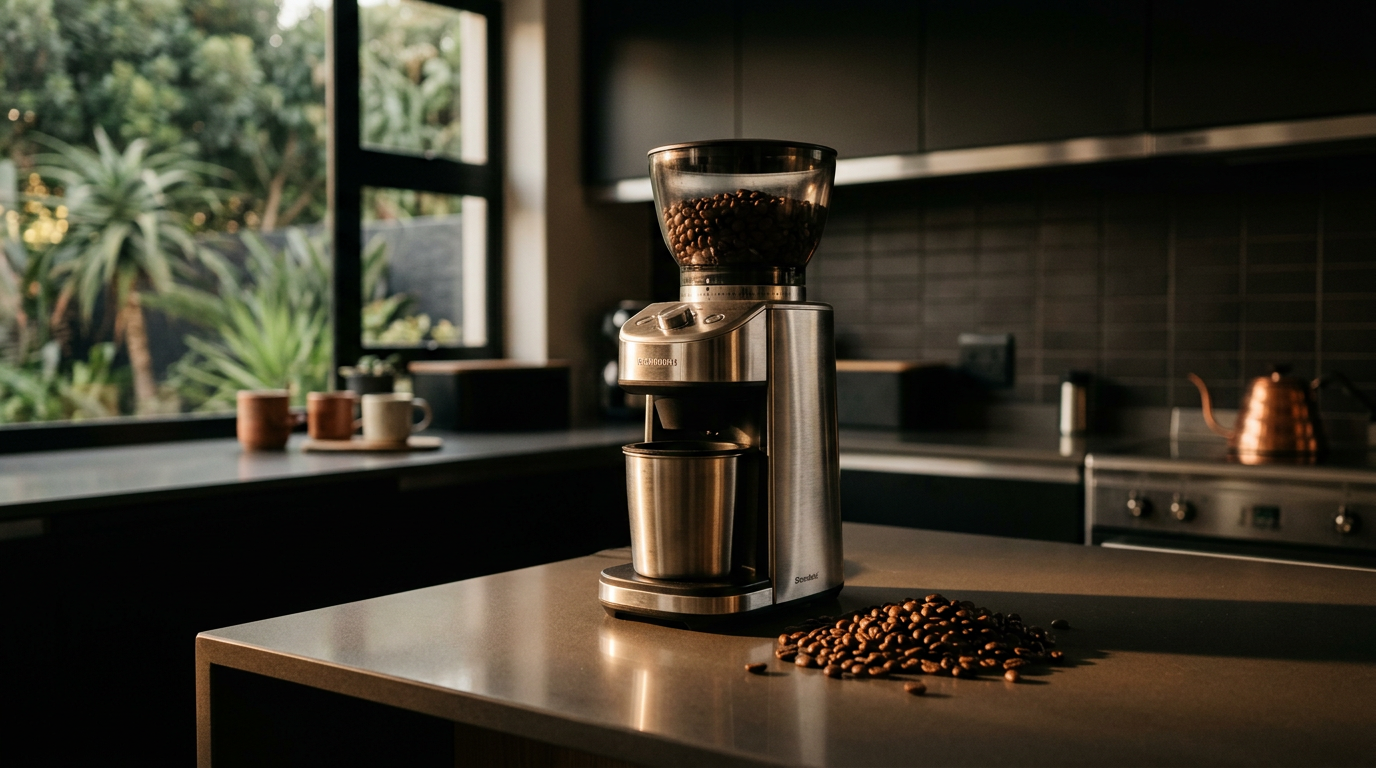
The grinder matters more than the machine — here's the best one I found under R1,500.
After checking South African prices on 23 August 2026, the KINGrinder K1 at R1,499 is the best manual espresso grinder under R1,500. If you only want Hario, Timemore or 1Zpresso, buy the 1Zpresso Q-Air (also R1,499). And if you can stretch R350, the Timemore Chestnut C3 ESP at R1,850 is the purpose-built choice.
That's the answer. Below is why — and the basket-by-basket honesty that no other South African grinder page gives you.
The verdict, up front
Three grinders, three situations. Pick the one that matches yours.
Strict R1,500 budget → KINGrinder K1 (R1,499)
38mm steel burrs, dual-bearing shaft, roughly 18 microns per click, 120 adjustment settings and a 25g capacity. This is the only grinder under R1,500 that can genuinely dial in an unpressurised espresso basket — the kind that ships with any decent machine. It's not effortless (manual grinding never is), but it's accurate where it matters.
Only Hario / Timemore / 1Zpresso → 1Zpresso Q-Air (R1,499)
If you're brand-loyal to the three names you see most often in SA, the Q-Air is the pick. 38mm heptagonal steel burrs, dual-bearing, about 25 microns per click, absurdly low retention (~0.1g in independent testing), and at 365g it's light enough to travel with. The catch: 1Zpresso itself positions the Q-Air in its pour-over range, not its espresso range. It can grind espresso-fine — it's just not designed to live there.
Can stretch R350 → Timemore Chestnut C3 ESP (R1,850)
The C3 ESP is the only grinder on this list that was purpose-built for espresso from the factory. 38mm S2C steel burrs, dual-bearing, roughly 23 microns per click, 60+ settings — and the "ESP" suffix is not marketing fluff. If your budget has any give at all, this is the correct Timemore for espresso.
How I compared these grinders
The 4 things that actually matter
Every grinder comparison devolves into spec sheets. I kept this to the four things that actually change your espresso:
Burr type and material — ceramic or steel. Ceramic is cheaper and stays sharp longer, but it's slower and less consistent at espresso-fine settings. Steel cuts faster, more uniformly, and with less effort. At R1,499, you can now get steel burrs — so the old argument that "ceramic is good enough for the price" has expired.
Adjustment fineness (microns per click) — how much the grind size changes with one click of the dial. For espresso, you want 25 microns or fewer. Anything coarser and you can't make the small adjustments that let you dial in a shot properly. This is the single number that separates "can do espresso" from "claims to do espresso."
Shaft and bearing stability — a dual-bearing shaft holds the burrs in alignment under pressure. A single bearing lets them wobble. Wobble = inconsistency = channelling = a shot that tastes sour on one side and bitter on the other. Every grinder I'm recommending has dual bearings; every one I'm telling you to skip doesn't.
Capacity and effort — how much coffee the hopper holds, and how long it actually takes to grind a dose. A 25g capacity is fine for espresso (you're pulling 18–20g doses). An 18g capacity means you can't even grind a full double without refilling. And a grinder that takes 79 seconds to grind 18g — yes, that's a real number — is going to test your commitment to the craft at 6am.
Why "microns per click" decides an espresso grinder
This is the concept most grinder pages skip, but it's the one that matters most.
When you dial in espresso, you're making tiny grind-size changes until the shot runs at the right speed. If each click moves the grind by 18 microns (like the K1), you can make surgical adjustments — one click finer, taste, one click coarser. If each click moves it by 50+ microns (like most Hario grinders), you're swinging between "choked" and "gushing" with no middle ground.
Here's how the lineup stacks up:
- KINGrinder K1: ~18µm/click — the finest adjustment on this list
- Timemore C3 ESP: ~23µm/click — purpose-built espresso range
- 1Zpresso Q-Air: ~25µm/click — workable, but officially pour-over
- Hario Skerton Pro / Mini-Slim Plus: not published, but materially coarser — and it shows in the cup
Below 25µm/click, you're in espresso territory. Above it, you're hoping.
Price-checked on 23 August 2026 — and why that date matters
Every price in this article was checked against South African retailer listings on 23 August 2026. I'm dating it because grinder prices in SA shift with the Rand, with stock availability, and with whatever Cape Coffee Beans or Buna Coffee happens to be importing this quarter. If you're reading this months later, the rankings hold — the prices may not. Confirm before you buy.
Notably: Cape Coffee Beans listed the KINGrinder K1, 1Zpresso Q-Air and Hario Skerton Pro all at the same R1,499. That fact alone should tell you everything about why the Skerton Pro is a bad deal in 2026.
The full comparison table
| Model | Price (ZA) | Burr type | Burr size | Microns/click | Bearings | Capacity | Espresso-ready? |
|---|---|---|---|---|---|---|---|
| KINGrinder K1 | R1,499 | Steel | 38mm | ~18µm | Dual | 25g | ✅ Yes — unpressurised |
| 1Zpresso Q-Air | R1,499 | Heptagonal steel | 38mm | ~25µm | Dual | 15–20g | ⚠️ Workable (pour-over positioning) |
| Timemore C3 ESP | R1,850 | S2C steel | 38mm | ~23µm | Dual | 60+ settings | ✅ Yes — purpose-built |
| Nuttii × Timemore Goosey | R950 | S2C steel (Timemore) | 38mm | 24 steps | Dual | 20g | ⚠️ Pressurised basket only |
| Hario Mini-Slim Plus | R949 | Ceramic | — | Not published | Single | ~24g | ❌ Filter/travel only |
| Hario Skerton Pro | R1,499 | Ceramic | — | Not published | Single | 60g | ❌ Skip — 79s for 18g |
| Timemore C2S | R1,998–R1,999 | CNC steel | 38mm | — | Single | ~30g | ❌ Above budget, not espresso-fine |
(All prices from South African retailer listings, checked 23 August 2026. Confirm before purchasing.)
The grinders, model by model
KINGrinder K1 — the strict-budget espresso winner
R1,499 · 38mm steel burrs · dual-bearing · ~18µm/click · 120 settings · 25g capacity
The K1's selling point is the ~18µm-per-click adjustment — the finest on this list by a comfortable margin. At espresso grind sizes, that translates to real control: one click makes a noticeable but not catastrophic difference to your shot time, which is exactly what you want when you're dialling in on a Sunday morning.
The build is all-metal, the 25g hopper fits a generous double dose, and the 120-setting range means this grinder doesn't just do espresso — it can stretch to filter and French press if you ever feel adventurous.
The honest limitation: it's manual, and espresso-fine grinding is work. If you drink four doubles a day, your wrist will have opinions by Wednesday. For one or two morning shots, it's entirely manageable. And if you outgrow the effort, KINGrinder's K6 is the electric upgrade path — but that's a different budget conversation.
Verdict: the best espresso grinder under R1,500 in South Africa, full stop. If you're running an unpressurised basket on a Breville Barista Express or similar, this is your starting point.
1Zpresso Q-Air — the portable all-rounder
R1,499 · 38mm heptagonal steel burrs · dual-bearing · ~25µm/click · 15–20g · 365g
The Q-Air is the grinder you buy when you want one device for everything — travel pour-over, AeroPress, and espresso in a pinch. At 365g, it's the lightest serious grinder on this list, and the heptagonal burr design keeps retention absurdly low (about 0.1g in independent testing — meaning almost nothing stays trapped in the burrs between doses).
The 25µm-per-click adjustment is the caveat. It's fine for pour-over and AeroPress, where small grind changes don't make or break the cup. For espresso, it means each click is a slightly bigger jump than ideal — you'll spend more time chasing the sweet spot between "too fast" and "choking."
The other honest note: 1Zpresso itself puts the Q-Air in its pour-over range, not its espresso range. That doesn't mean it can't grind espresso — it clearly can — but the manufacturer doesn't promise it will excel there.
Verdict: the best all-round manual grinder at R1,499 if you value portability and versatility. For dedicated espresso, the K1's finer adjustment wins.
Timemore Chestnut C3 ESP — the purpose-built stretch
R1,850 · 38mm S2C steel burrs · dual-bearing · ~23µm/click · 60+ settings
If your budget can absorb R350 more than the K1, this is the grinder I'd point you to. The "ESP" suffix means Timemore built this specifically for espresso — the S2C burr set, the stepped adjustment range, the entire geometry is optimised for the fine end. At ~23µm/click and 60+ settings, you get more than enough precision to dial in an unpressurised basket without the K1's slightly finer (but slightly more effort-intensive) approach.
Timemore's build quality has a deserved reputation — the C3 ESP feels like a tool, not a toy.
Verdict: the correct Timemore for espresso. Not the C2, not the C2S, not the standard C3 — the C3 ESP. If someone tells you "just get a Timemore," this is the one they should be specifying.
Nuttii × Timemore Goosey — best cheap pressurised-basket option
R950 · Timemore 38mm S2C burrs · dual-bearing · 24 settings · 20g
The Goosey is a collaboration between Nuttii and Timemore, and the spec sheet punches well above R950: genuine Timemore S2C 38mm burrs, dual-bearing shaft, and a 20g capacity that fits a full double dose. At this price, there's nothing else close.
The catch is the 24 settings. For a pressurised (dual-wall) basket — the kind that ships with entry-level machines and creates its own back-pressure — 24 clicks is plenty. The basket forgives the gaps between steps. For an unpressurised (single-wall) basket, 24 settings is too coarse a ladder: you'll find yourself stuck between "one click too fine" and "one click too coarse" with no middle ground.
Verdict: buy this if your machine has a pressurised basket and you want the best grind quality for under R1,000. Don't buy it expecting to dial in an unpressurised basket — you'll fight it every morning.
Hario Mini-Slim Plus — travel and filter only
R949 · ceramic burrs · plastic body · ~24g capacity
The Mini-Slim Plus is fine for what it is: a light, cheap travel grinder for pour-over and AeroPress. Ceramic burrs are slow and inconsistent at espresso-fine settings, and the build is mostly plastic. At R949, it's R550 cheaper than the K1 — but if you're grinding for espresso, the money you save will cost you in frustration.
Verdict: a perfectly adequate filter grinder. Not an espresso grinder. Don't let a retailer convince you otherwise.
Hario Skerton Pro — skip it at R1,499
R1,499 · ceramic burrs · 60g hopper · glass container · ~79 seconds for 18g
This is the grinder that made me write this article. The Hario Skerton Pro costs R1,499 — the same price as the KINGrinder K1 and the 1Zpresso Q-Air. Same price. Ceramic burrs instead of steel. No published micron-per-click spec. And in independent testing, it took approximately 79 seconds to grind 18g of coffee.
Seventy-nine seconds. For context, that's long enough to pull the espresso shot, steam the milk, drink it, and wonder why you're still grinding.
The 60g hopper is generous — it's the one spec where the Skerton Pro leads — but nobody needs 60g of hand-ground espresso at once. You need 18–20g, ground well and ground fast. At R1,499, the K1 does both; the Skerton Pro does neither.
Verdict: a legacy grinder at a 2026 price. Skip it.
Timemore C2S — now above budget
R1,998–R1,999 · 38mm CNC steel burrs · ~30g capacity
The C2S sometimes appears in "budget espresso grinder" roundups, but at R1,998–R1,999 in South Africa, it's above the R1,500 line and — more importantly — it's not an espresso grinder. The standard C2/C2S is tuned for filter and pour-over. If you're going to spend nearly R2,000 on a Timemore, the C3 ESP at R1,850 is R150 cheaper and actually built for espresso. There's no scenario where the C2S makes sense for this use case.
Verdict: wrong Timemore, wrong price point.
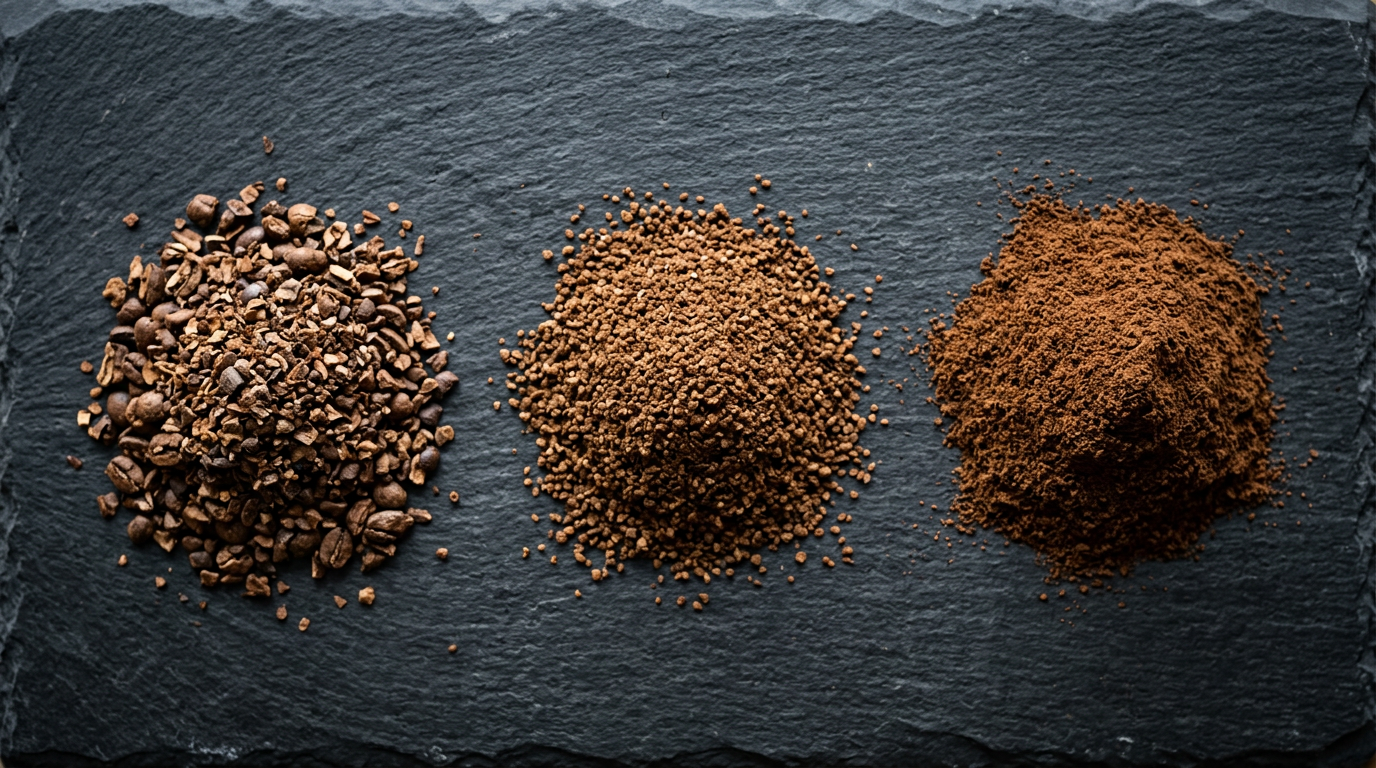
Coarse to fine: the grind range a burr grinder gives you — and why consistency is everything for espresso.
Pressurised vs unpressurised baskets — the decision that changes everything
This is the section most grinder reviews skip entirely, and it's the one that actually determines whether a grinder works for you. Every espresso machine ships with a basket — the metal cup that holds the ground coffee — and the type of basket changes the grinder requirement completely.
Pressurised (dual-wall) — what it forgives
A pressurised basket has a second wall with a tiny hole at the bottom. The basket itself creates most of the resistance that produces crema and pressure, regardless of how fine or consistent your grind is. This means:
- The Q-Air works fine. Its 25µm/click is more than enough.
- The Goosey works fine. Even with only 24 settings.
- Even a Hario is acceptable — the basket does the heavy lifting.
If your machine came with a pressurised basket and you're happy with it, you don't need the K1. Buy the Goosey at R950, save R550, and spend the difference on better beans.
Unpressurised (single-wall) — what it demands
An unpressurised basket is just a metal cup with evenly spaced holes. There's no second wall, no built-in resistance. All the pressure comes from the coffee puck — which means grind size, consistency and distribution are everything. This is where:
- The K1 is the minimum. Its 18µm/click gives you the control to dial in.
- The C3 ESP is better. Purpose-built for this exact scenario.
- The Hario and Goosey are out. Not enough adjustment precision, not enough consistency.
If you've upgraded to an unpressurised basket — or your machine shipped with one (Breville Barista Express, Lelit, Rancilio Silvia) — the grinder is no longer optional equipment. It's the component that decides whether your shots are drinkable. The K1 at R1,499 is the cheapest way to meet that bar.
My final buying order
- Strict R1,500 budget, unpressurised basket → KINGrinder K1 (R1,499)
- Brand-restricted to Hario / Timemore / 1Zpresso → 1Zpresso Q-Air (R1,499)
- Can stretch R350 → Timemore Chestnut C3 ESP (R1,850)
- Cheapest option for a pressurised basket → Nuttii × Timemore Goosey (R950)
Grinders to avoid for espresso
Hario Skerton Pro — R1,499 for ceramic burrs and a 79-second grind time. The K1 exists.
Hario Mini-Slim Plus — fine for travel pour-over. Not for espresso at any price.
Timemore C2 / C2S (standard) — tuned for filter, now above R1,500 in SA, and the C3 ESP is cheaper and better for espresso. Wrong tool for the job.
Pair the grinder with good beans
A grinder this precise deserves beans that reward the effort:
- See how roasters actually score → the taste-tested ranking of the best coffee beans in South Africa
- Automate the supply → the honest guide to SA coffee subscriptions — once the grinder's dialled in, let the beans come to you
- Learn the language → the glossary (conical burr, micron, single-wall vs dual-wall basket, retention)
- Dial in properly → the dial-in guide
- See every roaster I've reviewed → the supplier directory
- How I score and review → the methodology
FAQ
What's the best manual espresso grinder under R1,500 in South Africa? The KINGrinder K1 at R1,499. It has 38mm steel burrs, a dual-bearing shaft and roughly 18 microns per click — fine and adjustable enough for a real unpressurised espresso basket. Grinding is slow and physical, but it's the best strict-budget match in South Africa right now.
Can the 1Zpresso Q-Air grind espresso? Yes, it can produce espresso-fine grounds, with very low retention of about 0.1g in independent testing. But it steps at roughly 25 microns per click, and 1Zpresso itself positions the Q-Air in its pour-over range — so it's a workable all-rounder, not a dedicated espresso grinder.
How much should I spend on a coffee grinder in South Africa? For genuine espresso, expect to start around R1,499 (KINGrinder K1, 1Zpresso Q-Air). The purpose-built Timemore C3 ESP is R1,850. Cheaper options like the Nuttii × Timemore Goosey (R950) work well for a pressurised basket, but won't reliably dial in an unpressurised one.
What's the difference between a pressurised and unpressurised basket? A pressurised (dual-wall) basket creates most of the resistance itself, so it forgives a coarser, less consistent grind. An unpressurised (single-wall) basket relies entirely on the coffee puck, so grind size and consistency become critical — this is where a grinder like the K1 beats a Hario.
Is the Hario Skerton Pro good for espresso? No — not at South African prices. It costs the same R1,499 as the K1 and Q-Air but uses ceramic burrs and took about 79 seconds to grind 18g in independent testing. At this price point, the steel-burr options are materially better.
Do I need a special grinder for espresso, or will any grinder work? For a pressurised basket, most grinders — even budget Hario models — will produce drinkable shots. For an unpressurised basket (the standard on better machines), you need fine, repeatable adjustment, typically 20 microns per click or better, plus stable burr alignment.
About the method
I'm Bibi Burness — still an amateur who's more interested in getting better at coffee than pretending I've arrived. This guide follows the same rules as everything else on Coffee Journal: no grinder was sent to me for free, no retailer paid for placement, and when I couldn't verify a spec, I said so instead of guessing. Prices were checked against South African retailer listings on 23 August 2026; if they've shifted since, let me know — accuracy matters more than being first.